The butt music is mock music
Or is this a caricature of the modern music that was played in the chapel of Bosch’s brotherhood?
In the Hell of the Bosch Garden, in the gap between the harp and the hurdy-gurdy – both as big as two-storey houses – black devils force a crowded group of men into an unpleasant ‘butt song’, which is notated in a choir book and on a man’s backside. The chorister standing above the ‘buttock notes’ – with a devil’s paws resting on his own shoulders – specifically draws attention to this.
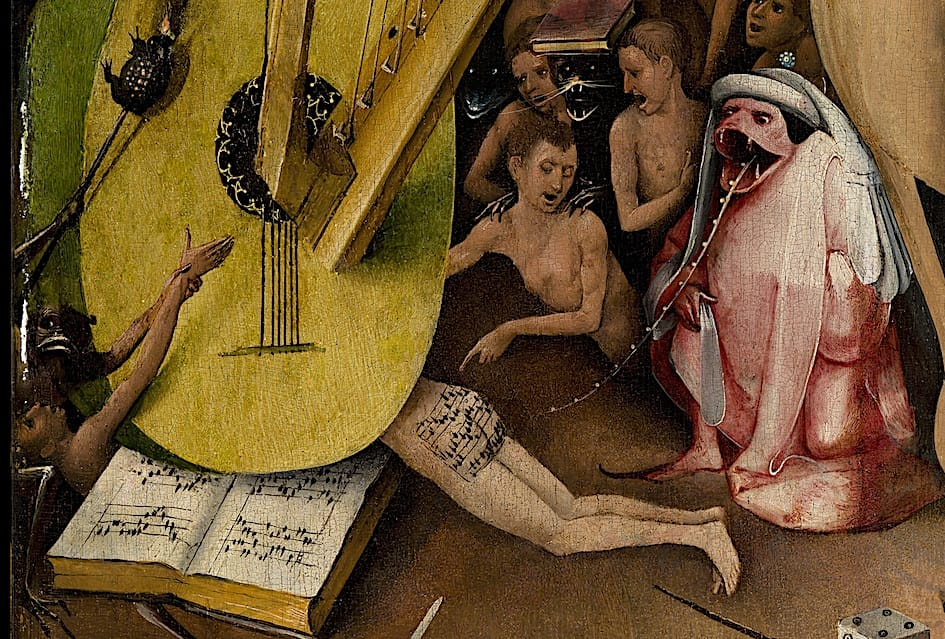
A few years ago, butt music made the news. A US student had distilled a modern version from the musical notation in 2014. This was made available online in a digital format with a slightly historicised sound. This attracted media attention. The ‘transcription’ can still be found on YouTube today.
Admittedly, there had been less widely noted attempts to make the notation on the buttocks and in the choir book legible in a modern context ever since Wilhelm Fraenger, naturally also undertaken by experts in the field. In the meantime, however, attempts to decipher a melody, dynamics, key, etc., from the notation on the buttocks have been abandoned. Music historians describe this detail as a caricature of a stroke notation that does not reflect any actual musical score. The butt music is consequently mock music. But perhaps – more on this in a moment – it should be interpreted as a gesture?
As noted here regarding the musical aspect of Hell, Bosch was a ‘sworn member’ of his town’s Brotherhood of Our Lady, a religious and civic association attached to the town’s main church. The ‘sworn members’ were responsible for church services and all religious festivals and certainly also had to make decisions regarding the music. The extent of Bosch’s involvement is unknown.
One can therefore only ask in general terms: did Bosch have an active relationship with the church music of his time, particularly with its innovations? The advent of polyphony was still a recent development, and in the city’s monastery churches the Mass continued to be set to music not in a polyphonic style, but in the austere tradition of Gregorian chant. What was Bosch’s attitude towards the denser interweaving of notes and voices, and towards the blending of secular and religious music, as exemplified by a composer such as Pierre de la Rue? De la Rue was in ’s-Hertogenbosch from 1489 to 1492; the painter undoubtedly knew him.
After all, it is explicitly the choir book that is maltreated; the music for the liturgy is what is meant. The punishment is thus directed at a choir performing its duties in the church. Could it be that Bosch found the music in his church too virtuosic and therefore not religious enough? He was no longer a young man, and he never became one of the moderns. A characteristic feature of the musical notation, both in the choir book and on the backside, is the crowding and disarray of the small, hastily scrawled notes. Perhaps, to stick with Pierre de la Rue, he did not accept the latter’s compositions – composed of interwoven six-part canons, flowing and varied rather than statically symmetrical?
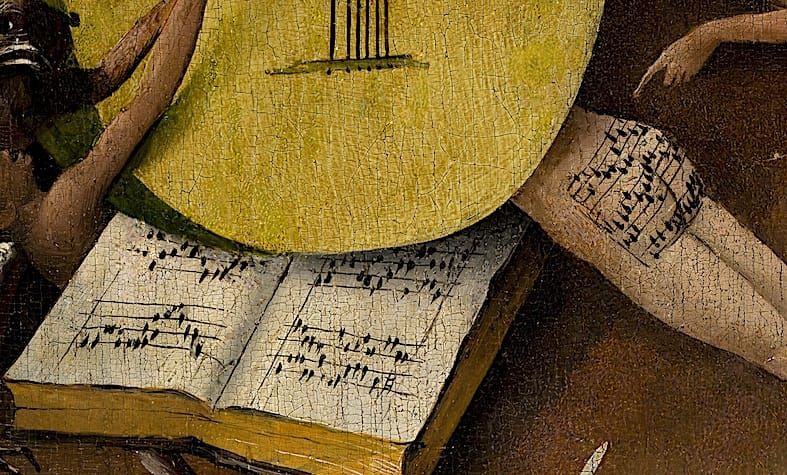
Certainly, the crowding captures very aptly the mockery of God-praising music – the music of measure and number – as diabolical anti-music as such. Whether the scene should be understood as the painter’s criticism of the music in his brotherhood or of modern practice itself remains a matter of speculation. Yet it is not a reckless interpretation. Since the musical notation on the backside does reveal an up-and-down motion – which will repeatedly tempt one to extract a melody – it may well be that its source melody was something everyone knew; the much-varied ‘L’homme armé’ – or whatever it was that he intended to thoroughly ridicule.
One can interpret Bosch, in his works on sin and morality, as an uncompromising hardliner. After all, music was racing at full speed in a direction that led the Church, at the Council of Trent, which began in 1545, to debate whether polyphony should once again be completely banished from the liturgy and Gregorian chant restored.
One contradiction remains. People had long been writing music on five-line staves. Why, then, does the painter depict only four lines – both in the music book and on the backside – if he really intended to caricature the new music? Undoubtedly, older choir books with older notations were still in use. In the sense outlined here, it would have to mean that Bosch intended to indicate the abuse through the chaotic storm of notes upon the old, venerable four lines. The idea that he might have wished to caricature the older music of the four lines as old-fashioned through this mass and confusion of notes – that can probably be ruled out.
Seen in this light, Bosch would thus have, through the densely set many notes of a kind of music that was, for him, impossibly convoluted and irreligious, already anticipated the Emperor’s later famous criticism of Mozart: very beautiful, but too many, ‘an extraordinary number of notes’. Paradoxically, the Garden of Earthly Delights, at least in the central panel, offers the aesthetic delicacy and sophistication (and frivolity) that the painter, viewed in this light, would have condemned in music.