A masterpiece and a devilish piece
The Garden of Earthly Delights is complex and detailed, yet not complicated
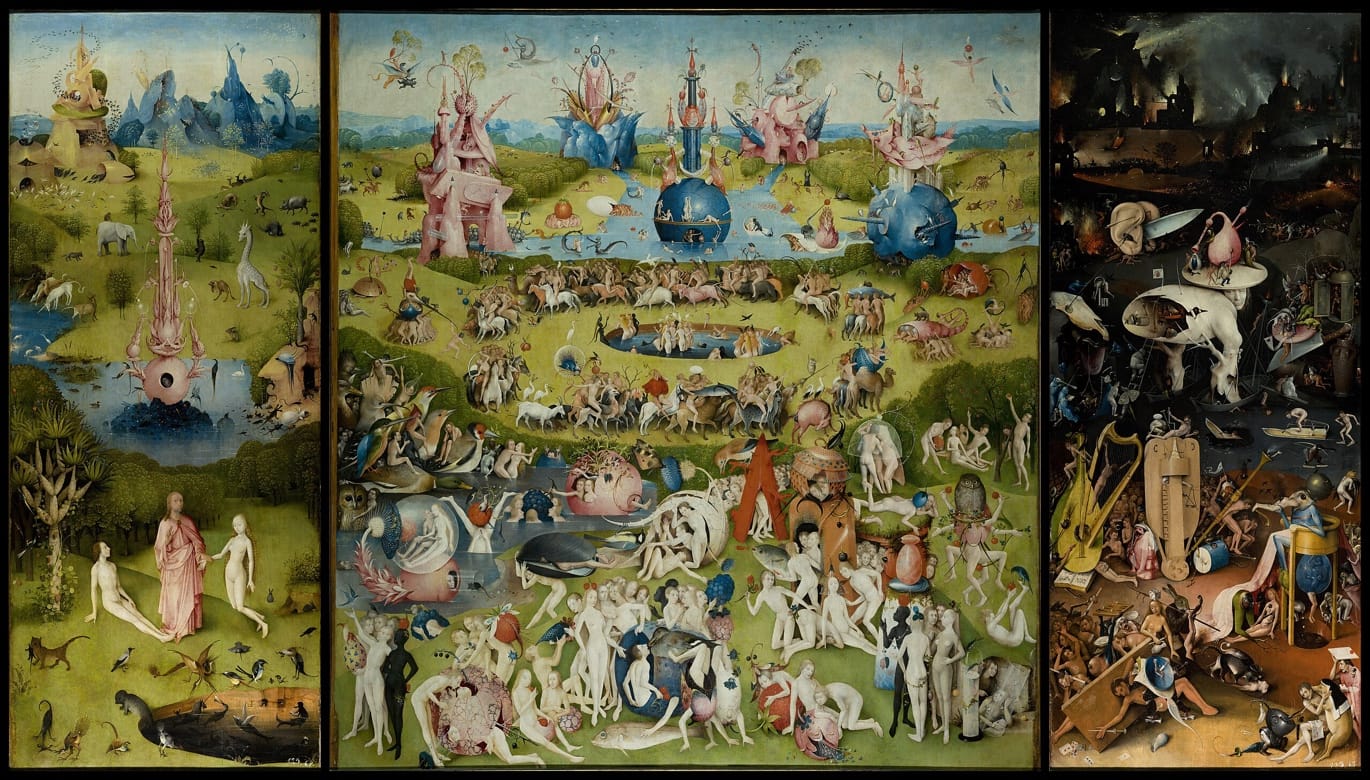
These pages are dedicated to Hieronymus Bosch’s Garden of Earthly Delights. The much-admired triptych is not a hidden object puzzle, but a sophisticated composition. The figures and groups are arranged according to a precise and fascinating plan. Nevertheless, the painting is essentially not complicated. It is logically based on the knowledge available around 1500 – in educated circles – for example, regarding the soul and the senses, dreams, sexual morality and religious awakening. The triptych, of course, remains within the bounds of the prejudices prevalent at the time. It is a witty, sensual and intellectual marvel and a misogynistic piece of work.
The fact that this is scarcely known is because the much admired painting comes across as somewhat insidious. It conceals its theses within irony and satire and in erotic revelry. It delights the senses and dazzles the mind. In this respect, it corresponds quite closely to the riddle-rich art of the late Middle Ages, particularly the literature of the Rhétoriqueurs, which was in its heyday around 1500; yet as a painting, such riddles are unusual.
For a long time, and in various ways, art historians have been searching for the wrong. In recent years, art history even seemed to have given up. The theory was put forward that The Garden of Earthly Delights refuses to make a concrete, tangible statement and that this intention resulted from new aesthetic principles at the beginning of the 16th century.
But these are mere excuses. The Garden of Earthly Delights can be understood. The painting contains instructions on how it must be understood – indeed, must be understood. One can discern what the commissioner intended by it.
Perhaps some of these remarks remain unclear at this stage: the following entries will open up new paths into The Garden of Earthly Delights. Certainly, not everything that has been written about The Garden of Earthly Delights to date is worthless; far from it. In particular, Reindert L. Falkenburg’s analyses of the Paradise Wing (in his 2011 book) are indispensable prerequisites. Yet the new approach presented here enables a much more detailed understanding and takes us much further. It is no exaggeration to say that it is only through this that the triptych becomes comprehensible.
Like so many others, I had found myself in the Hieronymus Bosch quagmire following a ‘Bosch initiation’. In 1994, prompted by a methodological problem, I initially wanted only to know why, in the Carrying of the Cross in Ghent – now excluded from the oeuvre – Christ’s gaze does not meet the viewer’s from his face in the centre, but from a lower corner, from the Veil of Veronica, and what effect this shift has. I noticed details that had not interested Bosch researchers – I read widely and deeply, and I was hooked.
Since then, I have been fighting my way through the undergrowth of this dense forest known as ‘Bosch’. I managed to clear the first few paths and make out the theological and ideological outlines. The Garden of Earthly Delights only began to open a crack in the door when I set out to write a chapter on it for a planned monograph around 2012/13. The monograph failed, partly because the crack in the door widened only slowly, laboriously and gradually, step by step, sometimes with months and quarters in between. Since 2014, I have devoted myself exclusively to this image. Although the frequency of eureka moments has decreased over time, important clarifications have still been achieved in recent years and months, including corrections of earlier errors and inaccuracies. I have published significant parts of my findings in essays. What remains to be done is to elucidate the political significance of the painting. Bosch scholars, blinded by nudity and eroticism, are completely oblivious to this as well. The triptych was presumably intended to give someone a proper ‘punch in the face’ (the correct term is in German ‘on the face’, but I prefer the first formulation).
The website also contains previously unpublished findings, and I will be expanding the collection bit by bit.
My protracted research, rife with dead ends, has consumed absolutely no research funding and has cost me ‘half a lifetime’ and many ‘pension points’ due to my own self-imposed blind spots. That is why, with a clear conscience, I am offering you the opportunity to contribute financially to my undoubtedly ‘exclusive’ offerings and to support their continued development, even if only as a gesture via the ‘buy me a coffee’ button. In any case: enjoy your time in The garden of earthly delights.