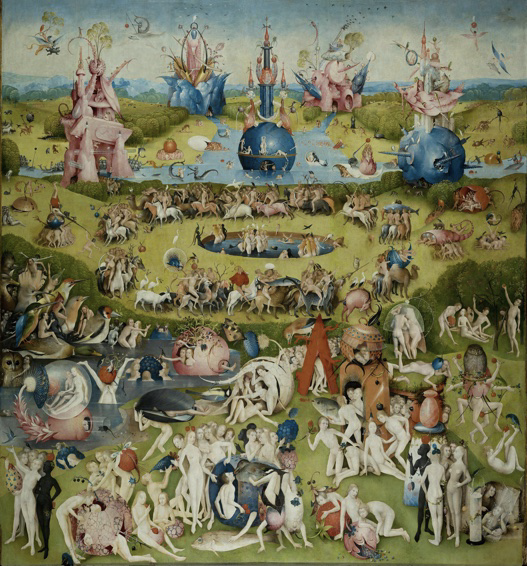
Psychology I: A Wheel of the Senses
Not entirely obvious, indeed concealed, yet extensively and ingeniously staged
To understand the Garden of Earthly Delights, the system of inner and outer senses had to be identified in the foreground of the central panel. First, we shall now discuss the circle or Wheel of the five senses, that is, the outer senses. The discussion of the hub of the wheel of the senses – the famous carrier of the mussel – and the inner senses or powers of the mind follows on separate pages; see here and here.
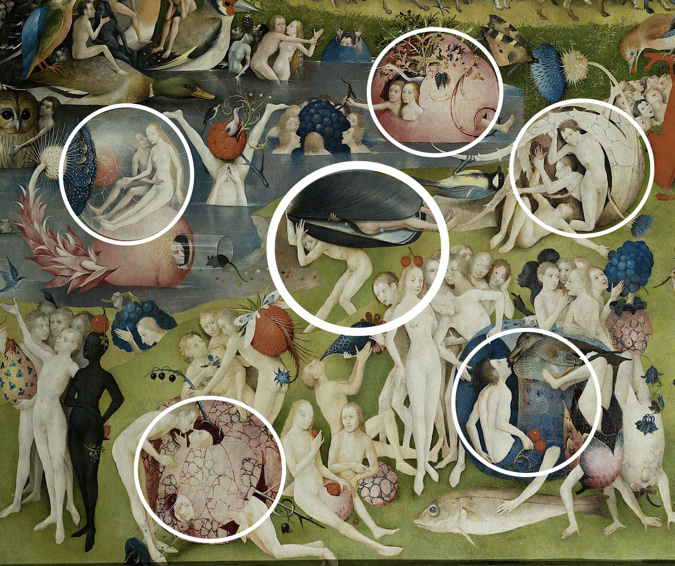
To the left of the centre are five large hollow fruit peels. As abstract forms and as fruit peels, they have already been the subject of extensive interpretation by Dirk Bax and Paul Vandenbroeck, all of it negative. This is very illuminating, but it is merely the colouring of a more important function. The structure of five had been observed several years earlier by a student project involving two universities in Bayreuth and Berlin, but no further action was taken. The websites documenting the project have unfortunately disappeared.
A significant part of the foreground action takes place on and within these ‘fruit peels’. Animals feed people, who embrace one another, touch one another, and speak to one another. They are engaged in secret pleasures that one can only guess at behind the peel and the shell. No other image in European art history is more delicate in combining the lustful activity around the fruit with sexuality. It takes place ‘in the viewer’s mind’, wrote Reindert L. Falkenburg.
Concealed meaning is part of the painting’s strategy, part of its method. There are reasons why the Wheel of the Five Senses has been overlooked until now. It lies hidden within the landscape. One must, as it were, lift up the five or six elements, must imaginatively extract the wheel of the senses. Nevertheless, one can be certain that this is precisely what is meant to be seen: for the components, especially in the upper section, are elaborately interconnected compositionally through a multitude of details.
The wheel is an older Christian model of the senses. In it, the Five Senses were symbolised by animals. It was only gradually that pictorial representations of the senses developed. The famous tapestry cycle of the Lady and the Unicorn (c. 1500) is the best-known example.
Like antiquity, the late Middle Ages was based on the Five Senses: sight, hearing, smell, taste and touch. Their hierarchy remained essentially unchanged.
The distribution and hierarchy of the senses in The Garden of Earthly Delights are clear in their basic outline and can be further understood through their context. The distribution follows a Christian moral hierarchy and a literary text.
Taste is presumably meant to be represented on the central axis at the bottom: the man is being fed. In the second fruit bowl, moving clockwise, the later iconography of the sense of touch is already discernible.
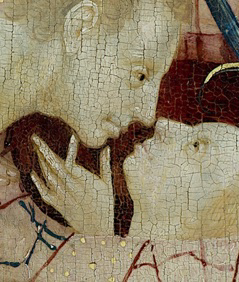
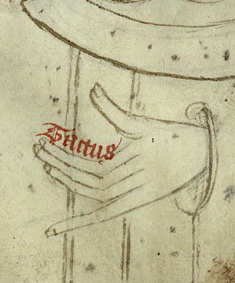
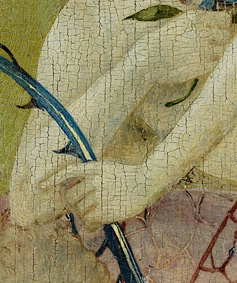
Detail of the sense of touch scene / Detail of Tactus in the Libellus de anima et spiritu, early 13th century. Trinity College, Cambridge, Ms. 0.7.16, f. 47r. / Detail at the top of the sense of touch scene: pricked by the plant’ thorn?
The seated figure reaches out with splayed fingers to touch the chin of the figure bending down towards her as if for a kiss. This resembles the depiction of the sense of touch in the pseudo-Augustinian Libellus de anima et spiritu, which is, in a sense, the earlier specialist literature. Furthermore, someone there appears to be pricking themselves on a thorn. The third station, with the transparent sphere, represents sight. Seeing through something is particularly emphasised as transparency.
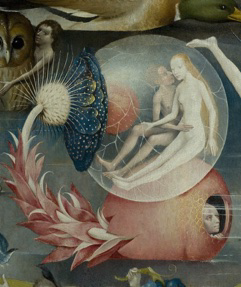
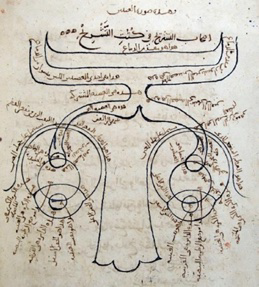
Detail: Sense of sight. / Illustration of the eye according to Alhazen, manuscript of Kitab al-Manazir, MS Fatih 3212, vol. 1, fol. 81b, Süleymaniye Library, Istanbul.
The double sphere ironically references the two eyes as depicted in optical treatises; one can recognise the anatomical structure comprising the optic nerve, the eyeball and the lens. The intense, loving gaze between the two figures speaks for itself – and for the sense of sight.
After that, from the fourth sense station onwards, the classification becomes uncertain. Yet, apart from the fact that older iconography provides a rationale for the top three senses: what should follow in a five-part structure in which taste, touch and sight appear? Especially since taste and touch occupy the lower spheres, just as they were classified as basic senses. Especially since, significantly, the lowest sense, touch, has been moved a few centimetres closer to the front edge of the picture – towards the viewer?
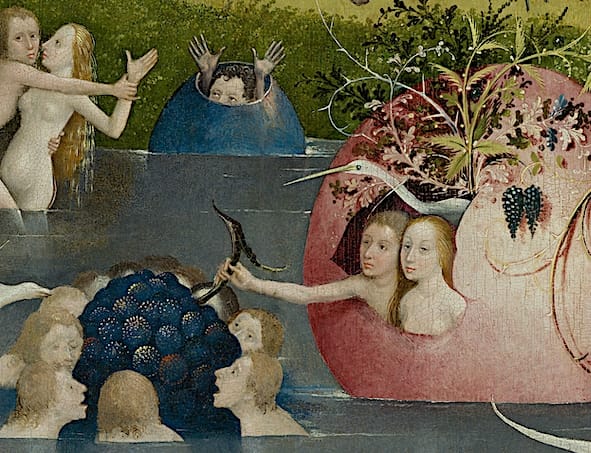
The sense of smell is symbolised by the fourth fruit sphere with its exuberant ‘rotten growth’ and the fruit’s overripe state, at which several mouths are feasting. Overripe, rotting fruit will, in turn, come to symbolise this sense a good century later, once a convention for the representation of the senses has been established. The scent of the thistle, which leans over from the last sensory station towards the smell sphere, goes without saying.
Before the fifth sense, hearing, is addressed, it must be emphasised that this Wheel of the Five Senses is not a neutral representation of the senses, but rather their abuse. It is the eyes of the body, not of the soul, that the sense of sight indicates.
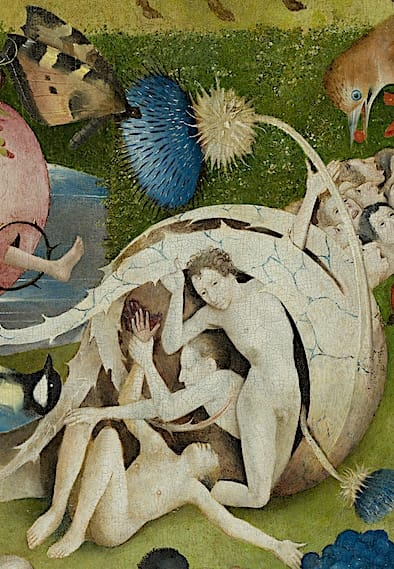
The fifth sphere – back on the central axis of the image – concerns hearing, presumably based on Richard de Fournival’s Bestiaire d’Amour, where hearing is depicted as the result of false – seduced – hearing, which paralyses and kills. The loud great tit – songbirds later enliven the conventionalised depictions of hearing – presumably even has a positive meaning here. But it was evidently not heeded.
For at the ‘end’ of the Wheel of the senses, the almost fatal consequence of false teaching is articulated. The appealing gaze of the kneeling man comments on his neighbour’s attempt at resuscitation. The circle ‘closes’ with the threat of death on the central axis between the wicked Paradise Fountain above – perverted by all manner of overhead aberrations and sex – and the secret (to be imagined) fellatio below.
We do not see a traditional Wheel of the Five Senses, because its depiction using animals was already too old-fashioned. We do not see a sequence of scenes such as those that remained relatively constant from the late 16th century onwards, because those years had not yet arrived. The scenic representation had not yet become conventionalised; the painter is breaking new ground. He classified the senses according to the accepted hierarchy – touch and taste as the lower senses – and may have drawn on Richard de Fournival, whose Bestiaire d’Amour was available in Burgundian libraries. According to Richard de Fournival, it is explicitly the three senses of sight, smell and hearing through which the infatuated lover succumbs to the lady and suffers the symbolic death of love. Hence, once again, we see taste and touch at the bottom and, from left to right at the top, sight, smell and the ‘finale’ hearing.
As it turned out, the five senses do not serve – as is often the case in literature – to depict the unimaginable luxury of, for example, paradise, but rather to strike a moral note. The Wheel of the Five Senses opens up a distinct layer of meaning within The Garden of Delights. See here how the circle is only completed into a traditional wheel by the mussel bearer, the ‘hub’.