Psychology II: The ‘Hub’ of the Wheel of the Five Senses
The Five Senses have a disreputable ‘guide and judge’
The circle stretching out across the landscape with the Five senses has a ‘hub’ at its centre: the figure holding the mussel. The figure quickly makes it clear that frivolous complicity is required. Inside the mussel shell lies – one must assume – a naked couple, namely a woman and a man. Even the way their bodies lie together is, by the standards of the time, reprehensible.
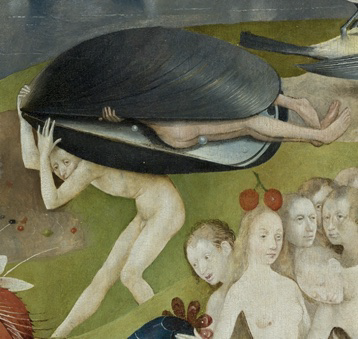
The smaller figure, the woman, is by no means lying beneath the man; that would contradict the prescribed position for the procreation of offspring. Reference is sometimes made to Brueghel’s use of a similarly employed mussel in his Luxuria; consequently, The Garden of Earthly Delights would also be said to refer to unchastity. That is correct, but by no means the whole story.
Once one has understood the structure of the five round fruit peels as representing the Five Senses, the conclusion is obvious that a hub must be intended in the centre. If further proof is needed that the five fruit peels are the earliest scenic representations of the five senses, it is this hub.
Admittedly, the five senses could stand on their own. They are often used, for example, to depict the delights of paradise. But if there is a characteristic sixth point related to the structure of five, then everything cries out for a psychological explanation. Here in particular, because the sixth point lies in the centre and extends the five stations into a six-part form, the traditional shape of the Wheel of the Five Senses. But also because the five senses are incomplete in a psychological sense on their own.
For what purpose do the senses serve: to perceive the external world. In every theory of perception from the late Middle Ages, there is a point—usually already belonging to the inner senses or powers of the mind—at which the external senses are coordinated. Their information is not in itself of much value; it must first be worked through inner processes. Only then do the impressions from the world reach the heart or mind in a meaningful way and become available to the soul. What remained constant was a sensus communis, a common sense, which synthesises the flow of sensory information from the external world. It brings the sensory impressions, as it were, into a unified form. Thomas Leinkauf called it the ‘point of convergence and unity of the entire perception’ (‘Konvergenz- und Einheitspunkt des gesamten Wahrnehmungsbereiches’); Augustine called it the ‘guide and judge’ (moderator et iudex) of the senses.
In short, the sixth position at the centre of the five-part structure is intended to represent the sensus communis, the soul’s fundamental systematic inner faculty. Essentially, this was foreshadowed in the earlier Wheels of the Five Senses featuring animals. There, too, a human was occasionally placed at the centre – one who allows oneself to be guided by the senses and thereby brings about one’s own sinful death. The idea of assigning a negative connotation to the hub of the Wheel of the Five Senses did not, therefore, need to be invented for The Garden of Earthly Delights.
Yet Bosch does not remain general in this detail either. The mussel itself is a brazen misogynistic diagnosis, just like the mating scene. For what does it convey: the ‘convergence point’, the ‘guide and judge’ of ‘the soul of the mussel-figure’, sums up the glances, attempted kisses and thoroughly suggestive touches in the five stations of the senses as sex in a frivolous position, pure unchastity.
Presumably one must even take it literally that a man wears this mussel, as it were, as an expression of his effeminate state? That is to be discussed here just as little as the fact that the imagination is set specific tasks.
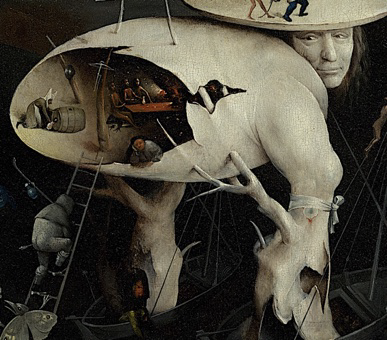
It should merely be noted that the immense ‘back arch’ which the man with the mussel assumes resembles two men in what I call the code of conduct, thereby also establishing a connection to hell. The man who, as it were, acts as the ‘hub’ of the senses whilst bearing the mussel – compare the curve of his ‘mussel-back’ – bends like the Tree-Man with his egg-back and gazes outwards just as he does. The fate of the shell-bearer is under threat. If he does not change, he will end up like the hellish Tree-Man.
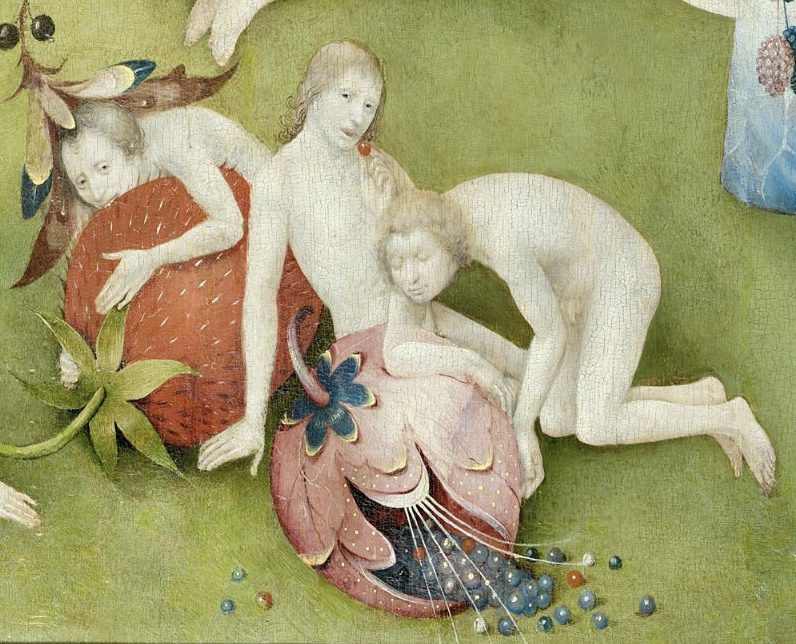
Adam sits bolt upright like the middle man in the ‘Code of Conduct’. His neighbours are bent over like the mussel-bearer and the tree-man.