The Code of Conduct for Understanding and Behaviour
Body posture as a moral distinction: the categories ‘upright’ and ‘crooked’ – with Adam as the model
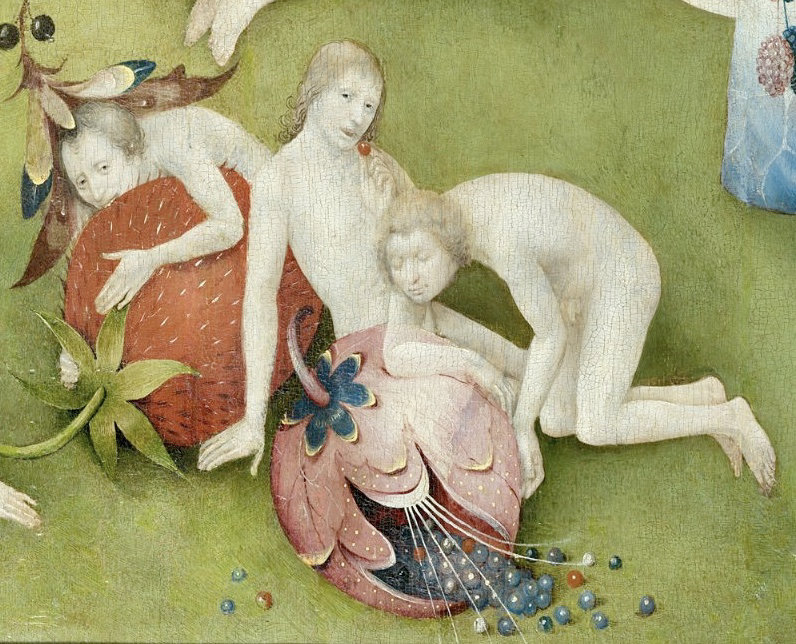
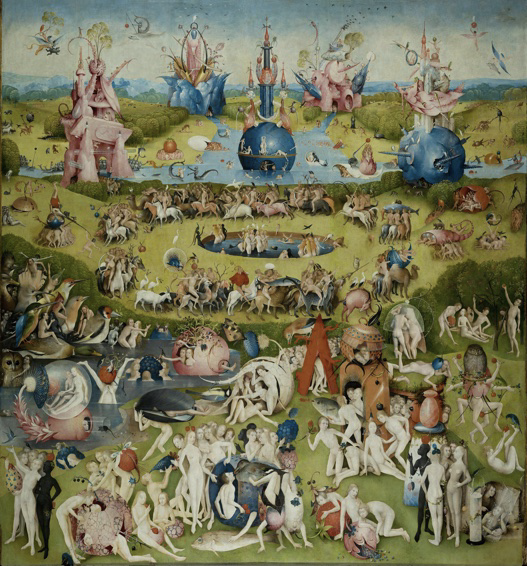
The fact that The Garden of Earthly Delights contains a moral lesson is already suggested by a group that, in the context of the Wheel of the Senses, must be understood as a behavioural precept or code of moral conduct. The scene also serves as a guide to interpreting the entire painting. It concerns the group of three men at the bottom right of the picture – that is, immediately at the ‘beginning’ of the circle of the senses (for orientation, see the central panel as a whole).
The trio is slightly isolated from its surroundings. It is highlighted because it has a special status; it conveys a separate aspect of meaning. The highlighted group belongs, in any case, to the ‘clusters’ in the lower panel that span the triptych from Paradise to Hell. The painter has also condensed the gazes from the central panel into the trio. At this point – with two figures looking out – they are as intense as in Paradise and in the cave in the lower right-hand corner.
Upright or bent – that is the difference: ‘code of conduct’ and the model of Adam.
What is happening: two men are handling two different giant berries in a parallel choreography of bodily bending. The one at the back greedily sinks his teeth into the strawberry flesh and looks at us. The one in front has his eyes closed; his expression suggests he is having a sweet dream; his left hand is ‘still’ nestled against the fruit. The third man sits upright between them, which emphasises the parallel bent posture of the others. He holds a fruit of normal size in his hand, if one takes it to be a strawberry.
The middle man sitting upright and his two neighbours differ in three respects: two are hunched, one is upright. Two are struggling with huge fruits, one with a small one. Two are eating or dreaming of the pleasure, one is pausing. He is not tasting it, but grasping the fruit with pointed fingers and pausing with his mouth open; he is demonstrating the act of eating the fruit. His appeal is the inaudible sentence that we must understand.
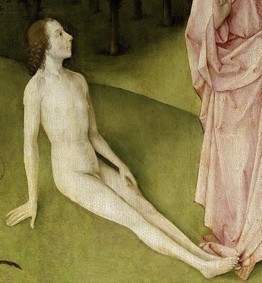
The comparison with the paradise panel is helpful. The man who is cautiously tasting or pausing sits bolt upright – like Adam. He supports his right arm in an almost identical manner. In contrast, the backs of the other two men are bent into a semicircle. With this arch of the back alone – which exactly mirrors that of the mussel’s carrier and the egg-shaped body of the tree-man – Bosch’s genius already conveys the tragedy of the ‘bent people’.
For it is hard to understand them as anything other than figures of homo curvatus (or incurvatus), the image of sinful humanity from Augustine right through to Luther.
According to Augustine, curvatus means that – since the The Fall of Man – man has turned away from heavenly things and turned towards earthly ones – bent downwards. God is no longer the focus of this man; instead, he revolves around himself. In general terms, the metaphor distinguishes between the person who looks to God and the person who looks to themselves and the world, between the sensual and the spiritual outlook on life, and ultimately between the path to heaven or to hell.
In this regard, it is revealing that the upright-seated Adam in Paradise was only ‘uprighted’ in the painting campaign. The preliminary sketch still depicted him propped up on his elbow, that is, half-reclining. This means that Adam was deliberately established upright as a positive example – and the man sitting upright in the trio repeats this. The scene is a perfect setup, because throughout the Bible and religious texts, correct and incorrect behaviour are contrasted and rectio intentio is demanded. The physical posture was regarded as an expression of the spiritual, which was, of course, the goal.
The gradation between the two bent figures contains differences that cannot be overlooked. One strawberry is red and magnificent, with a ring of green leaves. The other is of pale reddish colour, unnaturally misshapen, shrivelled, and burst open. Yet the man at the back has an unnatural structure on his head that, in terms of form, resembles the shrivelled fruit of his stooped counterpart at the front. The two bending men therefore belong together not only because of their posture. As far as the trio is concerned, this means that their behaviour – upright/bent – distinguishes the three men more strongly than the different ‘food’ that separates the two bending men from one another.
Generally speaking, the code of conduct calls for an upright posture and warns that a bent posture leads to hell. What is the main activity in The Garden of Earthly Delights? People are eating fruit. It is reasonable to assume that, before any other level of meaning – for example, mystical sweetness – the use of the senses is meant first and foremost.
The first admonition relates directly to moderate use – as conveyed by the varying sizes of the fruits. Furthermore, it deals quite specifically with the sensuality of the flesh and its dangers – for hidden sex is also offered. The Garden of Delights reveals itself, through the identification of the Wheel of the Five Senses and the code of conduct, as an essay on the senses and the soul.