Upside down into the glimmer of hell
Or is there still a chance to take off that wicked dress?
It can always get worse. Just to the left of the code of conduct, right next to the fruit sphere representing the sense of taste, two figures are leaning upside down. This posture reveals their attitude. They are not upright at all; they are no longer merely bent over, as to the right of them. They are standing on their arms, upside down.
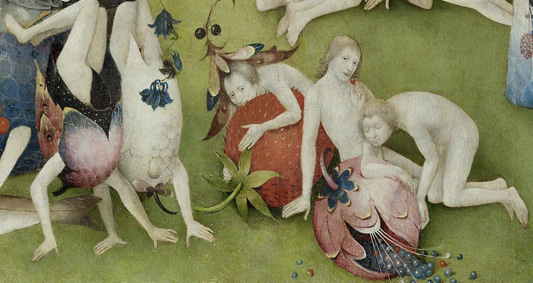
Several motifs underscore their debacle. The two figures wear animal-plant-like capes. One can make out the jagged edges and hems of the coverings around their whitish bodies. In The Garden of Earthly Delights at the Prado, they have a plant stem or an inflorescence with petals in place of their heads. In an early copy, one sees twisted heads there, but the difference does not alter the moral argument.
The motif of the evil garment that one can wear – through evil behaviour – goes back to Bernard of Clairvaux. In his highly evocative sermons on the Song of Songs, there is also a passage in which he speaks of the loss of the likeness to God through the Fall. Instead, he argues, humankind has brought upon itself a resemblance to an animal. Yet this need not remain so for all time, for humankind has merely worn the sinful, animal-like garment. The old skin has not been lost. What matters to him is that the sinfully acquired animal likeness can be ‘shed’ at any time and the likeness to God regained. In this sense, the plant and animal ‘garments’ of the figures are to be understood metaphorically. One can make out wings; the figure on the right appears to be surrounded by a broken eggshell, from which hang strange bellflower blossoms.
Once again, the threat of punishment in hell is made. For the Tree-Man, with his branch-like legs, his egg-shaped body and his animal skin, is also a plant-and-animal metamorphosis. In other words, the reversal from human back to animal and plant, initially depicted with the figures upside down, is anything but a wild carnival jumble. It is not topsy-turvy, and the tree-man is not a random monstrosity. The transformations are set within an eschatological perspective; they depict the threats to the human soul and its punishment as a reversal in hell.
Just how distorted the two figures are, and especially the one on the left, is demonstrated by another motif. The inner layer of the left figure’s garment is deep dark blue, densely dotted with small whitish-yellowish spots.
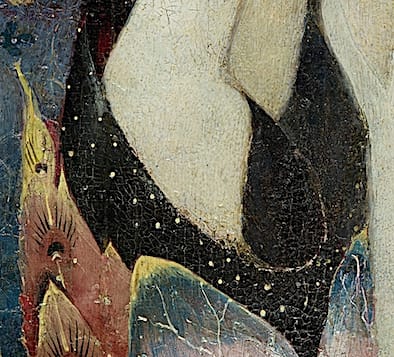
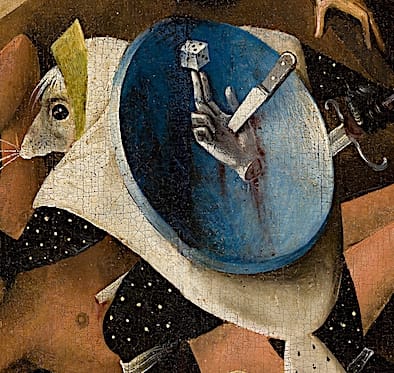
Kindred spirits sometimes give themselves away through the design of their clothing.
The same design characterises the mouse-devil in hell. Hence the description ‘the very worst’ in the caption. The figure to the right, already ‘the worst’ in terms of her covering and posture compared to the two merely stooped men beside her, is at least free of the devilish design.
Finally, no less important is the fourth motif of these two figures. It shows how their transgression arises. It is again the figure on the left, the ‘devilish’ one. She rests her feet against the duck – always understood in a negative light. She even places one foot in its feathers or under its belly.
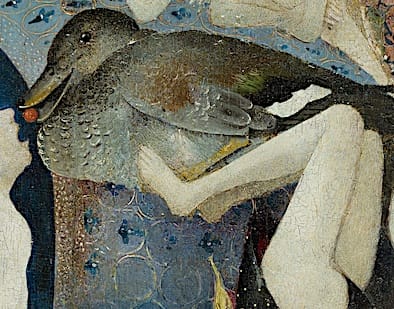
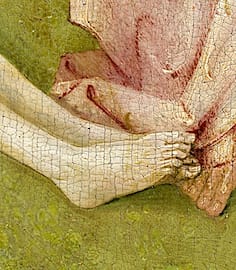
Where feet are depicted, they can reveal one’s disposition: towards the duck and towards the Creator.
This is a parody of the event in Paradise where Adam rests his left foot against the Creator’s robe. Reindert L. Falkenburg has discussed this scene in detail. During the ‘deep sleep’ at the creation of Eve, Adam receives a share of divine wisdom. This inner connection is signified by the touch of Adam’s left foot on the Creator God’s robe – almost at the toes! Furthermore, Adam crosses his feet slightly, which – according to Falkenburg – can be understood as a reference to the death of the ‘new Adam’, Christ, on the cross. The Paradise scene brings together the Type of ‘creation/birth of Eve’ and the Antitype of ‘birth of the Church’ (on the cross of Christ) anyway, as Falkenburg also demonstrates on the basis of the Bible Moralisé.
The figure upside down mocks this lofty significance of Adam’s foot gestures. She bases her fate on the duck, or rather on an animalistic mindset, etc. No wonder she must be depicted as diabolical.
It thus becomes clear that the code of moral conduct and the two figures upside down must be understood together. The differentiation of behaviour in the code of conduct – which serves as an interpretative guide for the entire picture – is complemented on the left by two figures behaving more wickedly – a theme which, incidentally, continues in the erotic interplay surrounding this spherical form, the sense of taste. At this point, it should simply be noted how intense the connections are between the Tree-Man and the figures in the code of conduct and alongside it. The view is still occasionally held that the central panel of The Garden of Earthly Delights unfolds a utopia of the free, including sexual, senses. That is, of course, entirely impossible.