Psychology III: The Mental Faculty of Reason
Poor Conditions: What the Soul Does with the Signals from the Five Senses
In the striking structure of five in the foreground on the left, half on land, half on water, a Wheel of the senses lies hidden in the landscape. The sense of taste is placed at the bottom of the blue sphere. Moving clockwise, we find the sense of touch, sight and smell. With hearing – the highest sense for (including religious) understanding – the circle returns to the central axis.
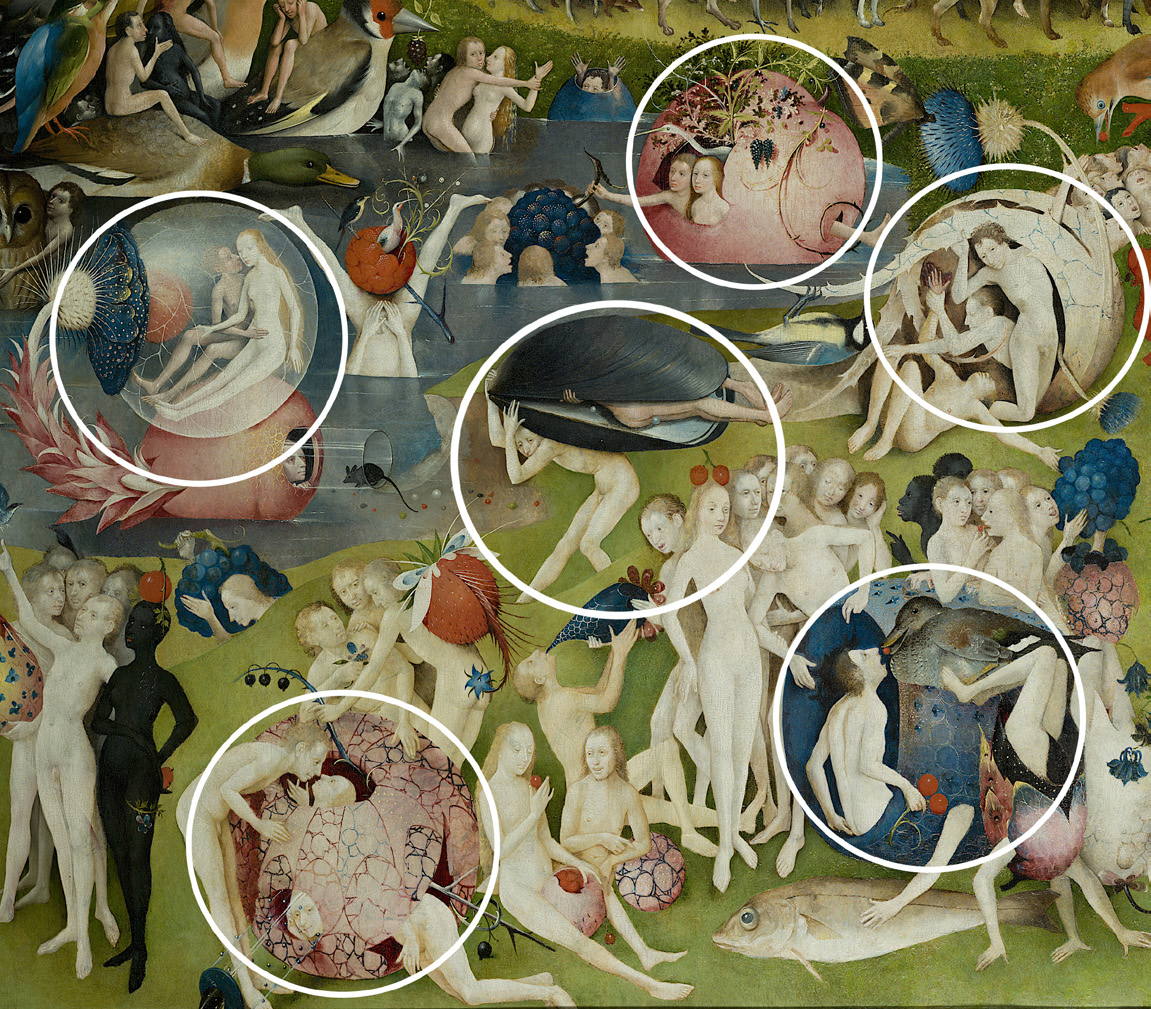
Every circle has a centre; here it is at least conspicuous, which is surely no coincidence. For every Wheel of the five senses has a hub – partly because every theory of perception prevalent in the late Middle Ages posits a faculty through which sensory signals are processed for further use.
This is usually a sensus communis, the common sense (see here). The shell-bearer, with his burden and the presumably copulating couple, reveals the sum of the sinful senses as blatant unchastity. This is not a recommendation, as the code of conduct and, alongside it, the scandal of the figures standing upside down prove (see here). In the code of conduct, the fatal ‘bending’ of the hellish tree-man is foreshadowed, and in the figures upside down the regression to a purely animal-plant-like state of the soul.
So it is somehow about the morality of the senses, about the soul and its spirit. This section explains how the psychology that began with the external senses continues on the right. Indeed, it ‘continues’, for adjacent to the pale ‘thistle ball’ on the central axis (sense of hearing), a group of three is appended to the right, as it were, as a logical continuation, in which the so-called inner senses or the powers of the mind (or mental faculties) are symbolised. As is well known, reason, memory, judgement, fantasy and imagination are essentially based on information from the external senses. We find them, as will be explained shortly, in the red tree-tent, in the brownish portal in the centre and the extension behind it, and finally in the bluish-whitish columnar form, which is half concealed by figures in the foreground on the right.
Don’t be afraid of science! Don’t worry, the sensual paradise remains intact. Nor is the interpretation presented here – which broadens our previous horizons and radically increases our detailed understanding – all that complicated. Detailed, yes, but not complicated.
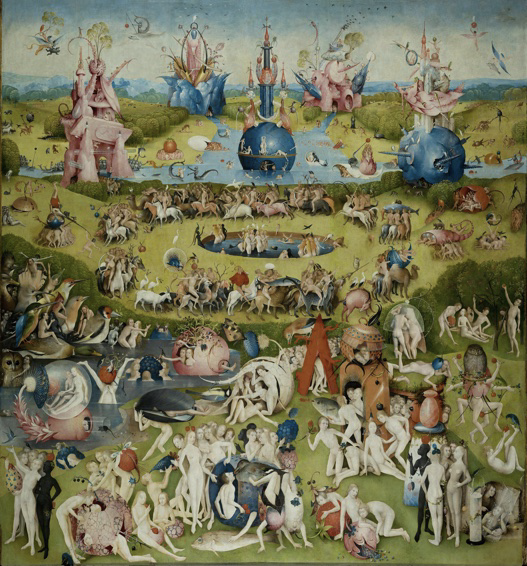
I can promise you this, as I hope the first few sections have already demonstrated: there is indeed a great deal to see. The painter Bosch is capable of far more than just depicting devils. He is theologically and intellectually astute, and he comes up with ingenious solutions. No, not fear, but fascination and respect: once you have grasped the whole system – with the external senses and the powers of the mind, with, to anticipate, dream and awakening, the compression of time into a single flap of wings, and much more besides – it is utterly fascinating.
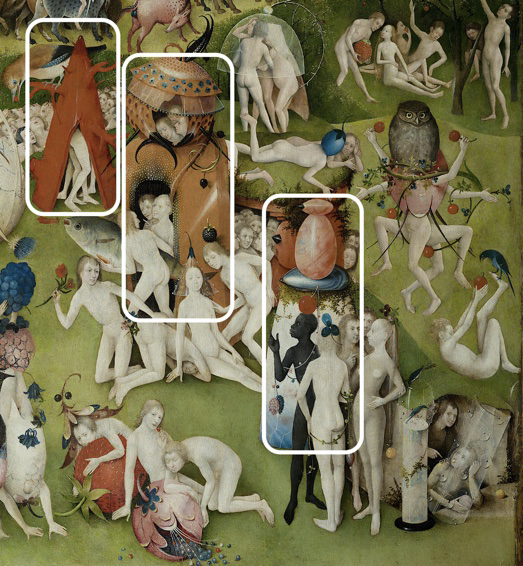
Three ‘small architectures’ for the powers of the mind or ‘inner senses’, as known from the three cerebral ventricles.
Starting from the cave at the bottom right, the three aforementioned ‘small architectures’ – I can find no better word – are arranged diagonally; with the tree-tent, they encounter, once again, the sense of hearing as the culmination of the group of external senses in the pale thistle sphere. It is to see: these three structures arranged diagonally from the cave to the top left demand an explanation – unless one assumes they have been placed so closely and in a line by chance – and that explanation is as a trio.
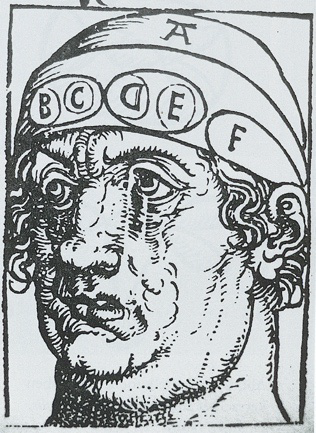
The explanation is therefore this: they serve as dwellings for the faculties of the mind or represent them symbolically. It should be recalled that these faculties of the mind were usually located in three ventricles of the brain. The depiction of a head attributed to Albrecht Dürer, featuring five faculties of the mind in three chambers, is an example of this. In The Garden of Earthly Delights, Bosch transformed them into three small architectural structures, with the three cerebral chambers, as it were, placed on the outside. This was not Bosch’s invention, as will be outlined in the following section on imagination, memory, fantasy and judgement (see here).
First, then, the tree-tent as a form for the intellect. The tree-tent, surrounded by a sharp outline, is often referred to as a coral, which is formally incorrect and misleading. It is a triangular form highlighted in red, which, through its opening, evokes a tent and, through its severed branches, a tree.
I found the first iconographic inspiration for identifying the triangular tree-tent as the intellect/reason in the work of Conrad Gessner (1516–1565), the Swiss polymath. He provided illustrations to accompany his exposition of Aristotle’s theory of perception. The illustrations provide information on the system of the senses and the faculties of the mind, the composition of the human soul and its relationship to the divine spirit. Naturally, the younger Gessner is not a source for Bosch, but an example of how older scholars might also have visualised Aristotle.
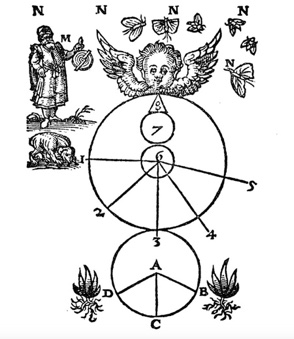
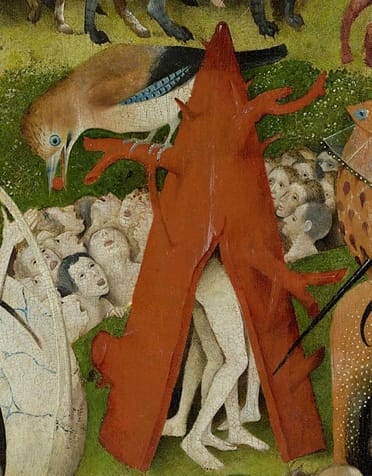
Gessner’s structure of the soul with the small dianoia triangle, Bosch’s triangular tree-tent.
In the Figura sexta, the higher spheres are represented by the angel with a head and wings. The theme is the position of humankind in creation between ‘below’ and ‘above’. To focus only on what is essential here: the larger circle beneath the angelic sphere contains the five senses (1–5), depicted as five lines of varying lengths. They converge in the sensus communis, the small central circle (6), as the centre of sensory perception. Above this sits the imagination or fantasy (7). The keystone of the mental processes is a very small triangle (8). In Gesner’s diagram, it stands for dianoia. Depending on how one draws upon the ancient thinkers, dianoia is understood both as the discursive intellect (as opposed to the more comprehensive reason) and as the human, active faculties of the intellect as opposed to divine wisdom as a whole.
In short: reason, the highest realms of the human mind that are still nourished by the senses and the earthly world, and at the very pinnacle, those through which it is capable of uniting with the divine Spirit: for it is there that the apex of Gessner’s dianoia triangle rises.
We shall see immediately why this is important; one further prerequisite must be established. The central panel is divided into three parts. The upper section, with the waters of the four rivers of Paradise, the four gates and the fountain, is followed by the middle section depicting the uncontrolled ride around the pond. The lower third is filled with the pale figures feasting on the fruits and enjoying each other’s company. Why is there this tripartite division, and why are the upper two areas only slightly separated from one another, whilst an immensely dense hedge grows between the middle and lower sections?
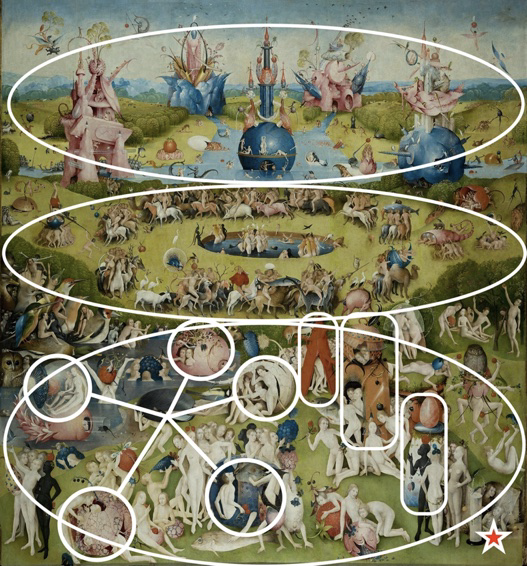
The explanation is as follows: the central panel is divided in accordance with the prevailing conception of the soul at the time: vegetative, animal, human. For a detailed explanation, I refer to the second chapter on the temporal structure of the image (following). What is important at the moment is that the dense hedge so consistently separates the lower from the middle area, because that is where the anima rationalis and the animal sensitiva collide – to put it simply: mind and body.
So what happens: the tree-tent (and, for example, the portal) juts out with its dark tip over the hedge into the central section, into the sensitive – one might say animalistic – part of the soul.
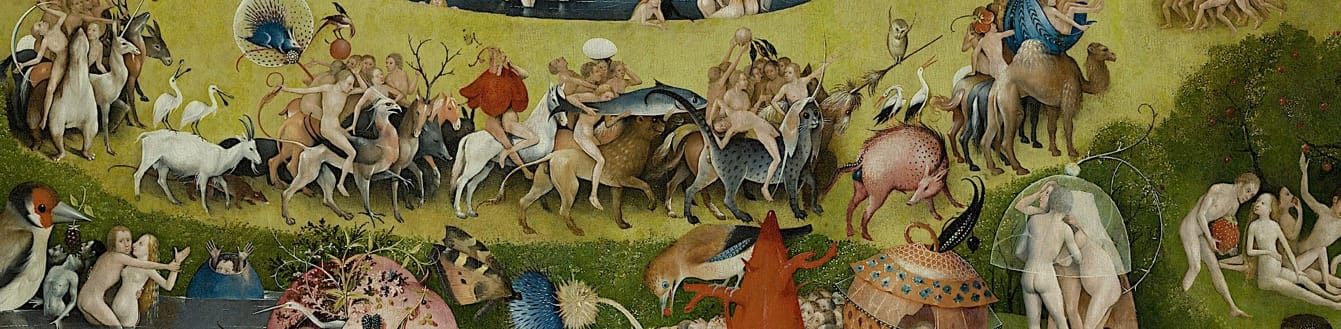
Because of this positioning, as it were, between two layers of the soul, a simple analogy with Gessner/Aristotle suggests itself. Diagrammatically and schematically, the triangle of the tree-tent is in the same position as the dianoia triangle in Gessner, on the boundary between body and mind. The highlight, however – fitting with the abuse of the senses – is this: the tree-tent does not project into a higher sphere, as with Gessner/Aristotle, but into the ‘animal’ one. What will such a fed mind think? One can see it in its opening.
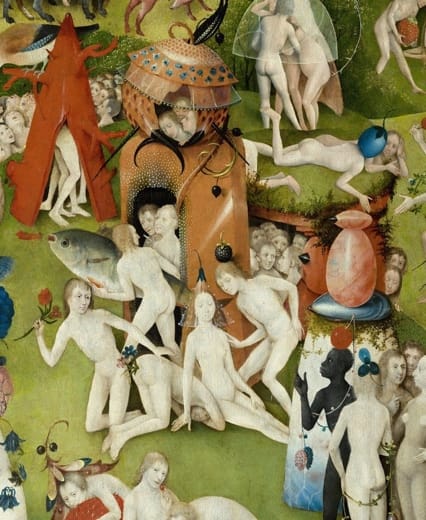
So much for the analysis based on the position of the tree-tent. Note how it towers, as it were, as the finale of the lower third of the picture. It is highlighted in red and positioned where two (unequal) triangles from the left and right and a diagonally positioned triangle from below meet ‘point to point’.
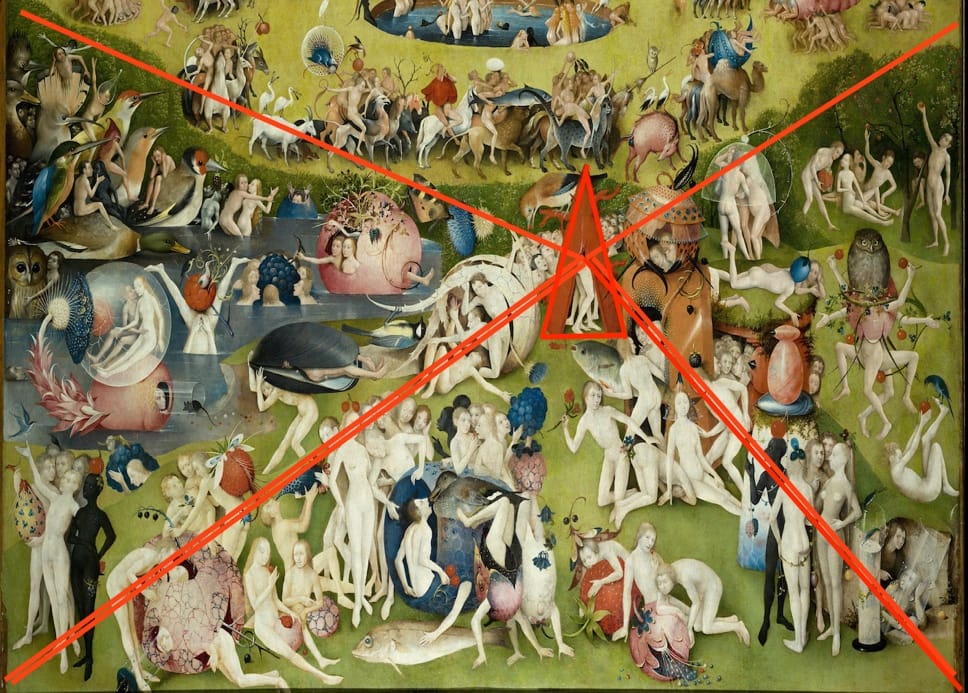
It acts as a hinge between the lower third and the middle third. And it is also formally defined: a triangle that is exactly isosceles and, apart from a deviation of a few millimetres, twice as high as it is wide!
On closer inspection, the tree-tent is therefore, in itself, a highly rational form. In short: here, measure and number reign supreme! This distinction of divine creation explicitly sets the tree-tent apart from mere fantasy, as will be shown (see here). Is it merely a coincidence that there are five larger branches, the stumps of which are visible, like the five senses? In other words, the tree’s natural shoots have been pruned in favour of a spiritual form, in favour of its geometry.
These details and the placement suggest that the tree-tent, like Gessner’s triangle, is a ‘form of the intellect’. The positioning is – in keeping with what happens inside the tent – a debacle. To put it another way, the triangle does not reach up into an ‘angelic zone’, as with Gessner/Aristotle, but ‘down into the body’. The reason is denounced. That very faculty of the mind which is meant to purify the defiling influences of the senses is instead sullied by the spirit of the bulging testicles that reigns in the riding circle. That the (five) limbs overlap in the tent, as repeated sexual activity is implied, is no more surprising than the misogynistic play on vaginal forms in the opening, whether based on a Dutch idiom or a pictorial practice to which Cranach the Elder also indulged (Golden Age, Oslo), or both.