When the senses dominate the mind
The Soul in Sleep and Dreams – Imagination, Memory and Evil Fantasy
Just as the rational geometry of the triangle in the tree-tent and its position explicitly characterise the intellect/reason (see here), the symbolism of the other two small-scale structures can likewise be inferred from their form and their arrangement in relation to one another. Having been led onto the trail of the intellect/reason – and thus of the powers of the mind – by Gessner’s diagram, the selection is thereafter manageable. In the late Middle Ages, four or five faculties of the mind were generally assumed (rarely, even more). Often, the number depended on whether a distinction was made between fantasy and imagination or not. Added to these were the faculty of reason (vis cogitiva), the faculty of judgement (vis estimativa), the faculty of memory (vis memorativa) and the sensus communis.
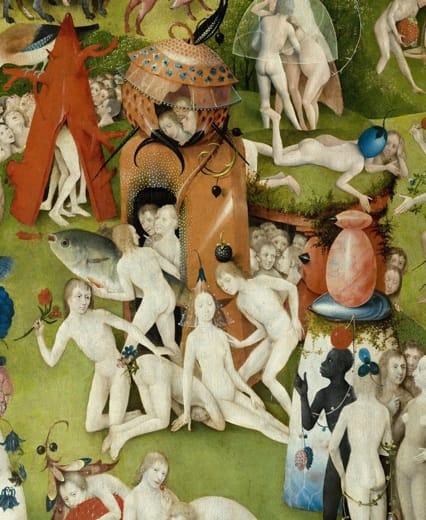
In the Garden of Earthly Delights, alongside the tree-tent representing reason, the portal with the annex behind it must be understood as (positive) imagination with memory. The column next to it, shimmering bluish-whitish at its base, represents (negatively understood) fantasy.
It seems paradoxical, yet there is no other possibility: the Garden of Delights, this epitome of creative imagination, delivers a negative diagnosis of the phantasia.
First, let us return to the practice of conceiving of such things as the external or internal senses or powers of the mind not as residing within the brain cavities of a head, but as being situated within the landscape and in architectural forms. A literary depiction of the external senses not within the head, but ‘in the external realm’, can be found in an older Conflictus animae. In it, a Court of Virtues is conceived at the Queen’s Soul. Many personifications of virtues and vices are active in the castle, the church, the house and indeed in five places – the Five Senses.
Just under a century after Bosch, the imagination of Edmund Spenser (1552–1599) already displays surrealist traits; in Book II of The Faerie Queene, he conceives a House of Temperance, an architecture of the soul. The tower of this inaccessible temple is home to the three most important advisers to Princess Alma (the soul). Placed at the front centre is the untidy eccentric Phantastes (accompanied by Cogitiva and Memoria). So there too: from the centre of the forehead to the centre of the spatial-architectural setting.
To the largest, central of the three small architectural structures. The portal with the annex behind it also hints, through its form, at what it symbolises. Men are pushing their way up from the rear and below; two stand on the threshold of the portal. One can discern in this the idea that the contents of memory travel from the rear, third chamber of the brain (where they were generally located) towards the front. Imagination was often attributed the greatest role in the processing of all signals. Thinking is possible neither without it nor without memory; they belong together. The portal should therefore represent imagination, and the annex memory.
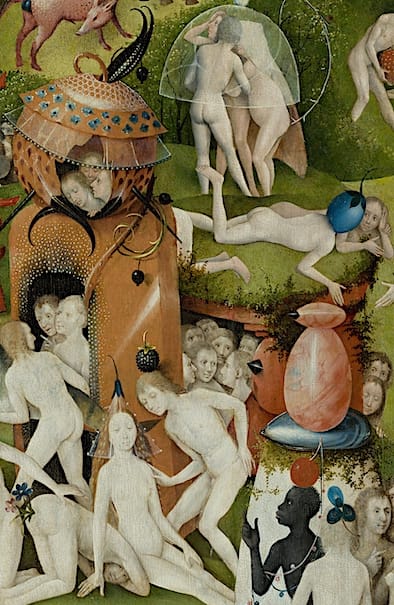
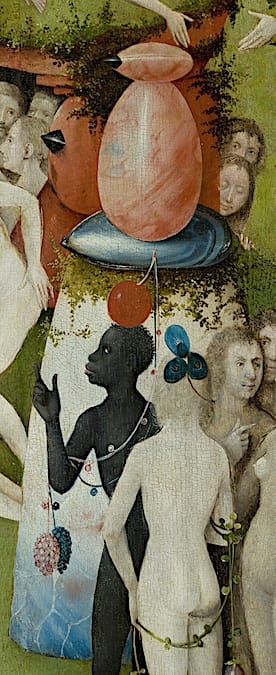
Small structures for memory/imagination and for the unreliable phantasia.
The fact that the mind is occupied with contents that rise unhindered from the rear would be the corresponding process for dreaming or sleep. The spiritus, the vehicle of mental processes, rises up the back and, when there are no current sensory impressions present during sleep, brings the information stored in memory to the fore. There it is subsequently processed by the cognitive and estimative faculties and by common sense (these processes were calculated differently).
It should therefore specifically refer to the workings of the psyche in dreams. This would, incidentally, confirm that the figure at the front of the cave was dreaming, that the entire central image depicts a dream (see here).
Another subtle detail points to mental activity during sleep and dreaming: on the left of the portal, care has been taken to ensure that there is absolutely no contact between the portal – that is, the imagination – and the tree-tent as the triangle of reason. For reason cannot intervene in a dream; it remains separate from what the imagination produces. We see the contents of memory ‘rising’ to the imagination, whilst the reason remains detached. Whereas on the opposite side, to the right of the portal, the transition between imagination/memory (portal/extension) and fantasy (whitish column) is fluid: for fantasy reigns in dreams as it pleases.
On the third piece of small-scale architecture: even the base of the bluish-whitish column, whose material is vaguely reminiscent of an egg, is brittle. Cracks run through the surface visible next to the black woman. At the top lies a shell – yet another shell. It rests, as if in a nest, upon the vegetation that haphazardly covers the tapered, surreal column and also grows up the sides. The slanted, precarious placement of the smooth shell in the nest is surpassed by the unstable position of the egg-shaped marble on top of the shell. This reddish marbled egg should, in fact, slide down at any moment. The small-scale architectural piece for the fantasy thus celebrates a formal atmosphere that seems to warn that figments of the imagination can collapse like a house of cards.
In contrast to the clear separation between reason and imagination, the fluid transition between imagination and memory during sleep is indicated here, as already mentioned.
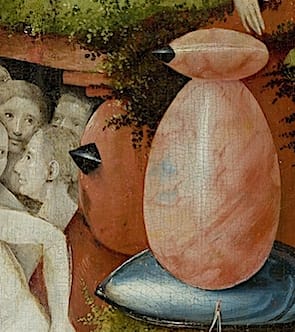
The two bulbous forms with two black tips pointing left, both on the extension of the portal and beside it as a marble egg, bear witness to this. For the thesis that the precarious instability of the small-scale architecture for the imagination also characterises the perverted towers of paradise in the background, thereby identifying them as bizarre products of a deceptive fantasy, I refer to the page on imagination/fantasy in the Garden of Delights (see here).
Thus far, a basic structure of perception and its processing would be in place: the external five senses plus common sense, reason, memory, imagination and fantasy, that is, five inner mental faculties as well.
It is possible that this list is as yet incomplete, because although a distinction has been made between the positive and negative effects of imagination, an evaluative mental faculty – estimative – which is currently missing, may yet be added. Well, the theorists of the soul were anything but unanimous, and it seems risky in any case to diagnose a concrete model of cognition within a visual representation. The Garden of Earthly Delights is not a theoretical treatise.
Nevertheless, the following consideration is legitimate. The vis estimativa might have been added as a satire. Because the tree-tent is the form of the power of reason, the scene behind it stands out as particularly witty in this respect. A red-backed shrike sits on a branch stub of the tree-tent and is apparently holding a fruit down in its beak, whilst a group of men open their mouths upwards like baby birds.
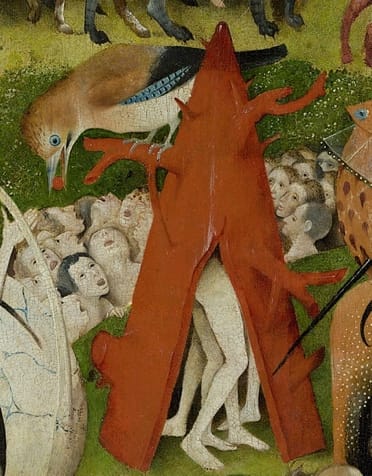
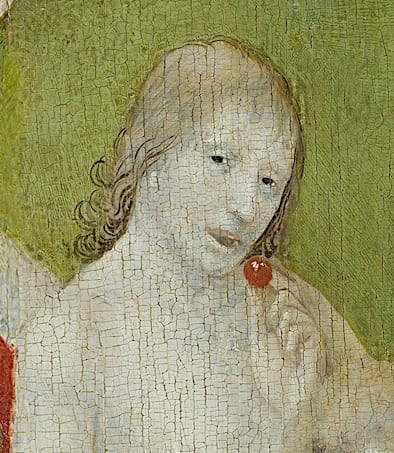
Animal greed as a caricature of the vis estimativa and exemplary tasting in the ‘code of conduct’.
Like other thinkers, Thomas Aquinas distinguished the direct-affective vis aestimativa from the vis cogitativa, which likewise produces evaluative judgements. He also distinguished between animal and human estimativa: the sheep reacts instinctively to the wolf; it is capable of assessing the situation correctly – we would say: instinctively. Humans do not lose this ability but expand it cognitively. This cognitive-estimative quality, as an already generalising and thus higher rational faculty, is reserved for humans.
However, according to Thomas Aquinas, infants would sometimes react affectively in a manner similar to animals. The infant reacts to the mother’s breast with its ‘hunger for food’ in an animal-like, estimative manner; this is the Aquinian example. Fundamentally, therefore, he distinguishes between animals and humans in estimative or cogitative terms and attributes a specific mode of operation to the vis aestimativa as an instinctus naturalis. One need not spend long explaining why the scene behind the tree-tent – the feeding from the symbol of intellectual power downwards – caricatures, with their instinctively gaping mouths, all those whose capacity extends only as far as the animalistic vis estimativa.
Thus everything would be brought together, and as with the external senses, as a fierce satire: intersecting limbs in a reason form, as it were, as a ‘tent of love’, fed in any case from the third with the unconscious ride of sin. Imagination also sends a tentacle there.
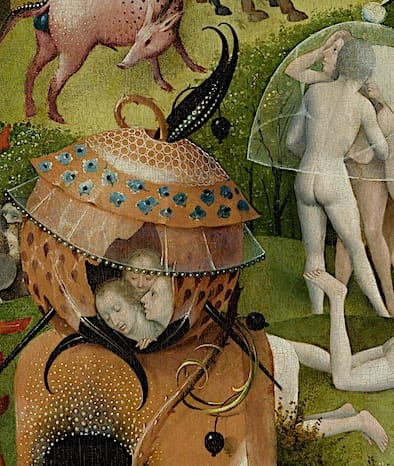
The portal of the imagination does indeed have a pretty bonnet – Peter Glum was reminded of the woman’s headdress in the ‘Gotha Lovers’. Yet the rest of the décor is anything but positive. Moreover, the rapt faces and the man leaning in from the far right provoke one (as Reindert L. Falkenburg observed) to suspect a sexual act taking place there – once again in a forbidden position. And now even as a ménage à trois? Memory may come off best, but it is, of course, merely a makeshift shelter, and for the denunciation of the imagination, one need only refer to the shell. In short: just as the external senses are, so too are the internal ones – the powers of the mind – thoroughly corrupted. How is God to save this soul?