Time structure part I: A heartbeat away
When timeless eternity and the brevity of a butterfly’s flap of wings coincide
The structure of time in The Garden of Earthly Delights could not be more exclusive. Alpha and Omega form the framework. The triptych begins on the exterior view with the beginning of creation and reaches its conclusion on the Hell panel after the 6,000 years of the world’s existence, a figure still calculated around 1500.
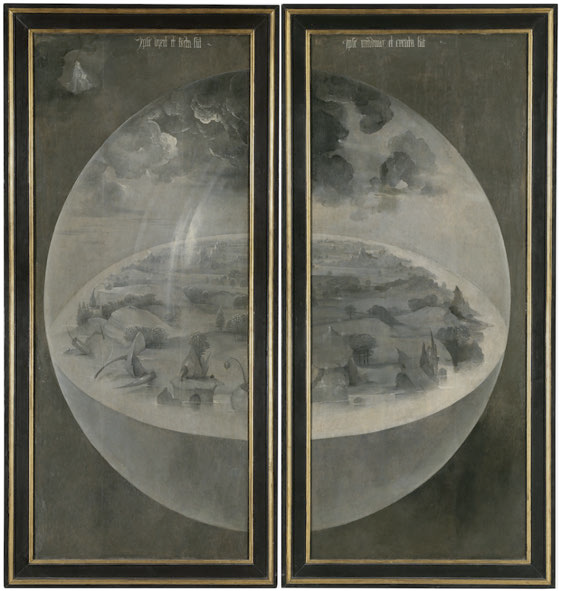
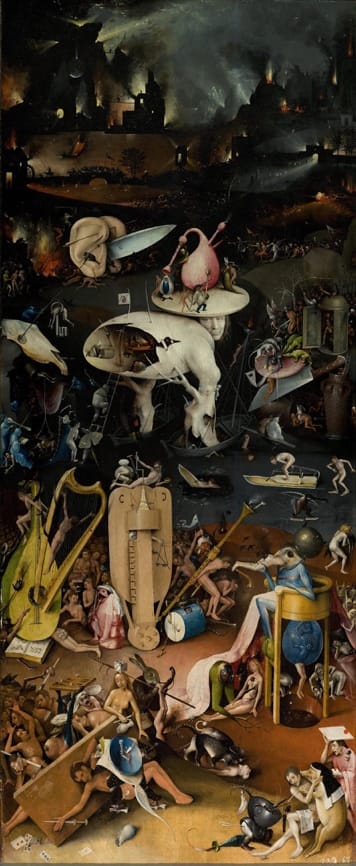
Exterior view with wings closed: God the Father above Creation; the end of the world on the Hell panel.
Usually, the third day of creation is cited as such: the water and land are separated. One can accept this and must expand upon it. For there is no description of a specific biblical moment, but rather an interpretation of creation. Two elements are essential here: firstly, the presence of the eternal light, that is, the eternity of divine love and grace and their relevance to creation. For light is to be seen before the heavenly bodies are created. And a sign of light is given. That is to say, the light of the first day of creation is reflected on the spherical dome. This is light par excellence, as the antithesis of darkness: the divine presence above all things. It cannot be a coincidence that its ‘reflection’ in the grisaille takes the appropriate three-part form of a rainbow, as it dominated the – black-and-white – medieval drawing. The rainbow is the sign that God gave to mankind after the Flood as a sign of the covenant. The Flood plays no role here; Bosch uses the sign for his interpretation of creation: here, now, at this very moment, the light shines that conquers the darkness.
The second emphasised element – one might say the opposite of the first – is the mystical simultaneity of creation. Essentially, the entire temporal structure of the triptych is already prefigured in this span of eternity and simultaneous mystical creation. God the Father points to the Book of Creation and upwards to the psalm quotation spanning both wings: Ipse dixit et facta sunt. Ipse mandavit et creata sunt – For the Lord spoke and it came to be; he commanded and it was there. (Ps 32:9, Vulgate numbering, also 148:5).
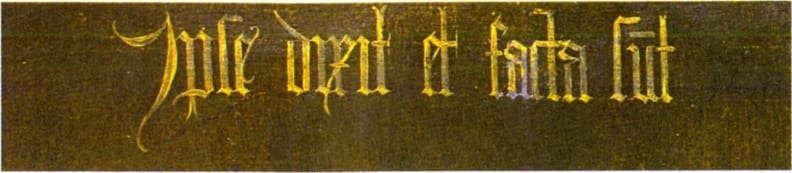
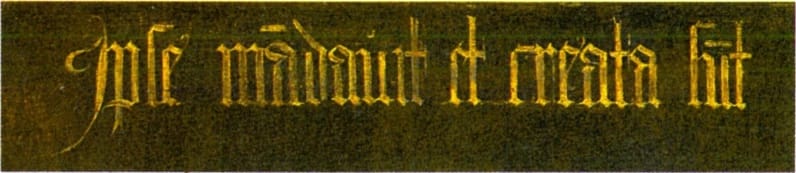
Inscriptions at the top of the panels: The Lord spoke and it came to be. He commanded and it was there.
The verses quoted emphasise the incomprehensible simultaneity of creation. God is the creator, incomprehensible to the human mind, whose word commands, who creates simultaneously and out of nothing, de nihilo and simul – and all came to be in the moment of divine will, with that ‘breath of his mouth’, as it says three verses before the quotation.
It is the point from which time first comes into being. Running through the six books of Augustine’s explanation of Genesis, it runs the assertion that God created everything at once. He impresses upon his readers that creation took place from a timeless eternity, that there was nothing before, because there was no ‘before’. All created things have only their own time and can only ‘taste’ of eternity – of God – in gracious exceptions. This will hold true right up to modern times.
To continue from there, even if it is not yet comprehensible here: one aspect of the temporal dimensions inherent in creation is captured by the curious butterfly. It is just about to land on the thistle; it is on the verge of doing so. And the position of its wings – half-open, half-closed – likewise signifies this mystical fleeting moment. For Augustine it is a heartbeat, for Jan van Ruusbroec a blink of an eye. Van Ruusbroec and others also use the flash of lightning to describe that mystical moment when a soul briefly gains insight into heavenly truth.
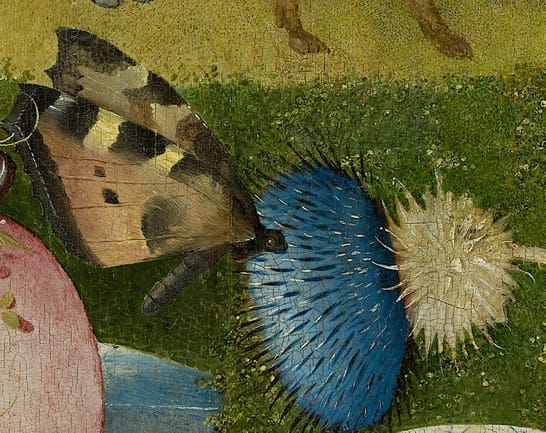
A brief note on the butterfly, which, in the characteristic depiction of a ‘Little Fox’, does indeed belong to the front third here – it sits on the thistle by the sense of hearing, and connects this, as it were, with the sense of smell (see here). But it is a devilish messenger, whose wings extends into the middle third.
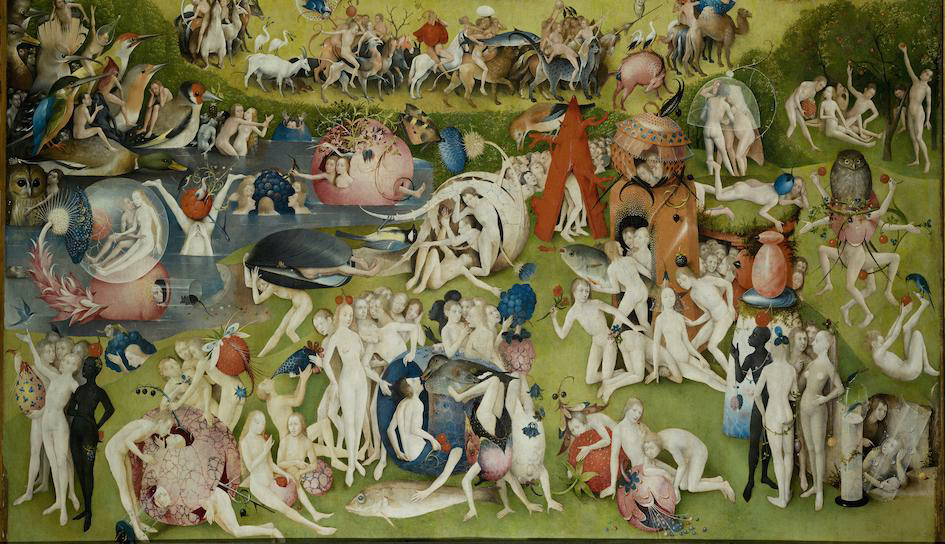
A sinful soul awakens from a dream in the cave at the bottom right (see here). Like all humans, she is tainted by ‘original sin’ through Adam and Eve, and her dream is certainly no mean feat (see here). Everything taking place in front of the cave on the central panel occurs within the woman’s dream. Rhetorically, it is ingenious to have her awaken at that very moment: the beginning and end of the dream narrative occur in the same place and at the same instant. The duration of the dream is reduced to zero, which corresponds to the interrupted continuum of time within the dream.
Moreover, rhetorical device and allegorical meaning-making merge. For awakening is not merely the end of a narrative, but a religious achievement. Here I would simply like to mention and leave as an assertion that there is also a sign of light in the cave denoting the religious, that is, the ‘spiritual awakening’. However this conversion was conceived, divine influence has always been regarded as necessary, and it was granted only briefly – as a flash of lightning, a heartbeat, here for the duration of a butterfly’s flap of wings. The fact that a bracket for a dream form is created both immediately before the cave and within the cave (see here) also bears witness to the minimal moment: awakening.
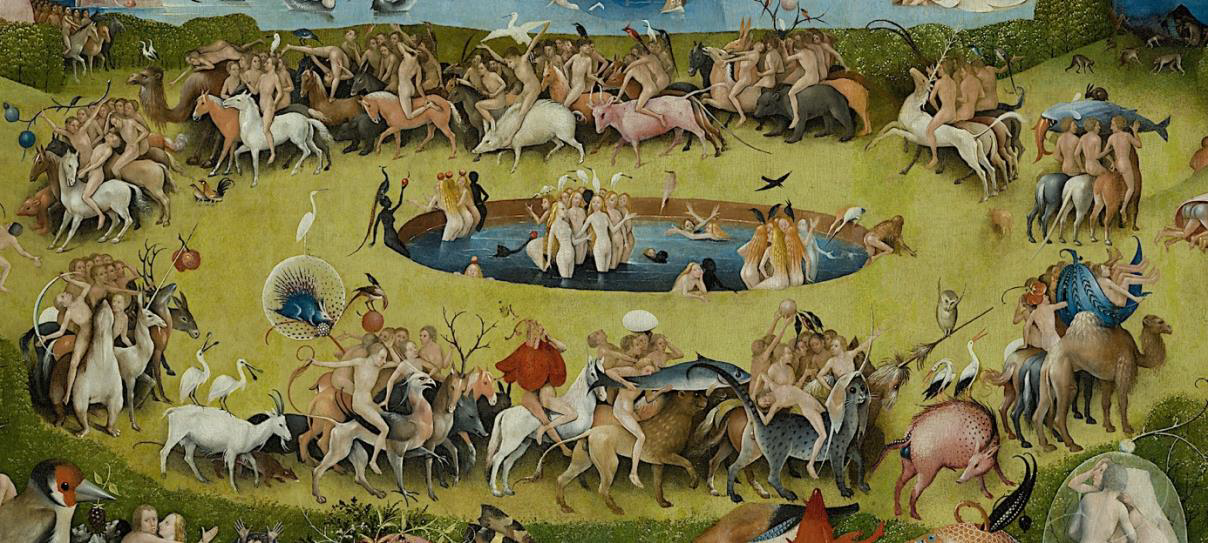
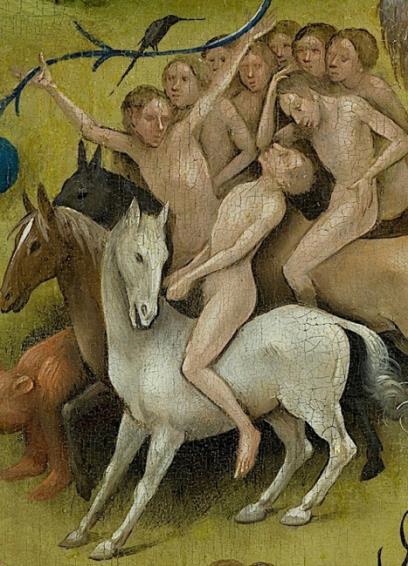
Let us mention just one more indication of suddenness in the picture. There is a consensus that the senseless ride around the pool in the centre of the picture illustrates a tragic fate. But there is hope. The rider on the white horse above the small gap on the left of the circle has just taken hold of the – invisible – reins. ‘Pulling on the reins’ was a recurring theme in moral literature. The rider has perceived a sign from ‘above’ and tightens his reins. The horse visibly stops. It plants its legs in the ground against the direction of travel, its centre of gravity already shifted backwards. The circle of riders comes to a halt; the evil course of sin – and thus damnation – is stopped! The fact that the circle is apparently being refilled by an imaginary monster also has a moral-theological background, but for now, only the momentary brief halt is of interest.
This is great cinema: what was bestowed upon the outer view of creation is redeemed in the cave for a single soul, as it participates in that eternity for a heartbeat whilst awakening. For there is no conversion without God’s assistance. Thus, in the cave, eternity and the heartbeat ‘intersect’, for here on earth the divine Spirit can be tasted only very briefly. The grand framework of time, established by the external view with eternity on the one hand and the simultaneous creation in the ‘breath of his mouth’ on the other, is, as it were, fulfilled in the ‘finale’ of the image. ‘The time is fulfilled,’ it says in Mark 1:15. It is, in itself, a fundamental tenet of theology, though as a pictorial concept it is, of course, ingenious. How the triptych is even more elaborately structured within this framework of eternity and the present is following.