The Dream of Life
On the art of finding salvation even in the sleep of reason
Starting from the task of finding an explanation for a striking 5/6 structure, the external five senses have been identified as the Wheel of the senses and its hub as the sensus communis. The abused external senses are continued in a triadic order of small-scale architectures as inner senses or mental faculties, which are also severely abused (see here, and here). The code of conduct conveys that this is not right. Last but not least, warnings have been issued (see here); the fate of the Tree-man looms. This ‘psychology’ occupies almost the entire lower third of the image.
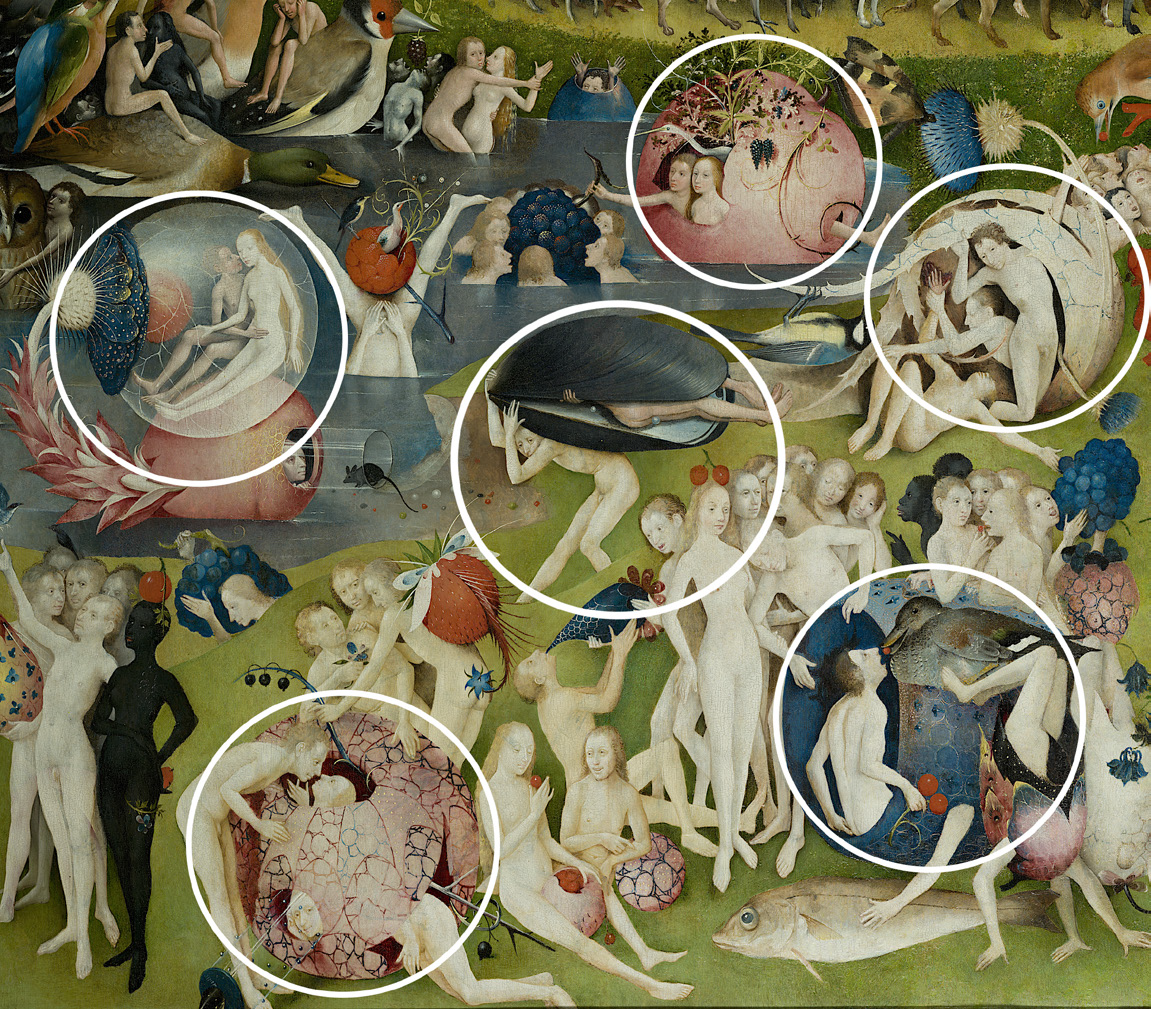
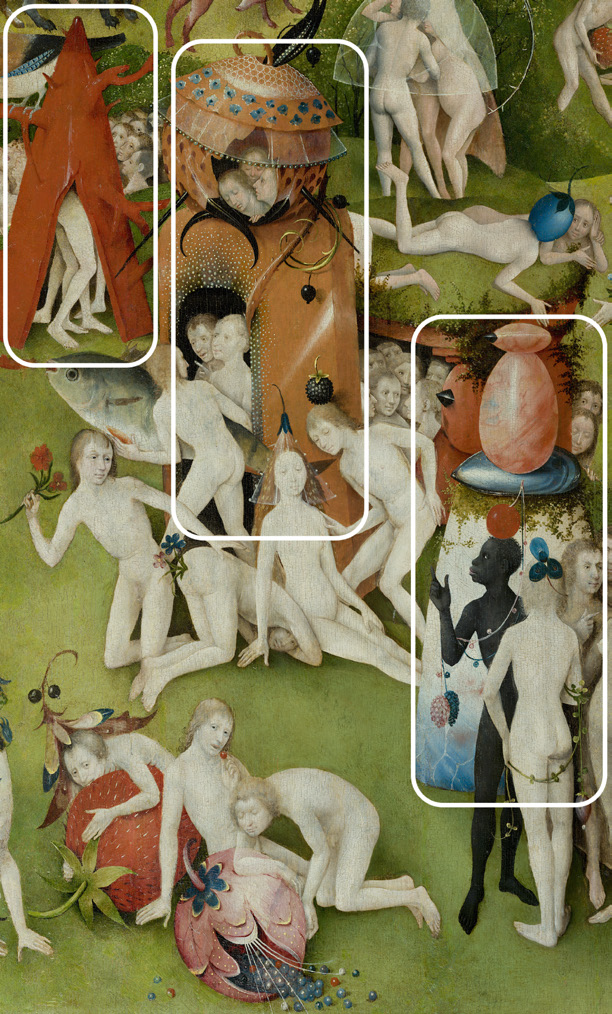
Five fruit spheres and their ‘hub’ for the external senses, and three structures for the internal senses/mental faculties. In between, a code of conduct and a further warning.
In the illustration above, however, one of the most important scenes in the picture is cut off on the right: the so-called cave. In fact, the three figures are situated below the grassy edge, which extends in a contrasting colour towards the centre of the picture to the portal with its annex.
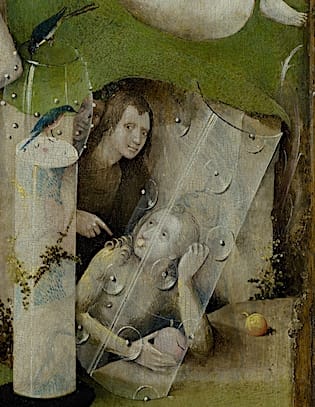
The exact spatial connection is unclear at the upper end of the darker grassy area; there, the impression of a tunnel emerging from the ‘cave’ fades away. In the ‘cave’, the figures are framed by perfectly straight wall edges. It would be better to speak of a cellar – which makes much more theological sense, though that is not at issue here.
Just a brief note on the gazes. I recommend covering the man’s left and right eyes in turn. You will notice that he is looking at the bird in the glass with his right eye and out of the picture with his left – as with several other appealing gazes elsewhere. The figure leaning on her arm is looking at the bird in the glass. I shall refer to her traditionally as a woman; there are opposing views, which, admittedly, know nothing of the psychology of the image. The index finger of a right hand (it doesn’t matter whose hand it is at first) points to the woman.
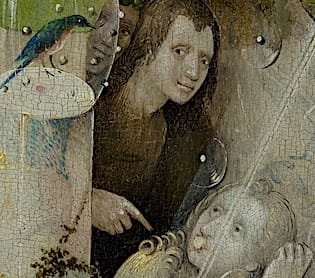
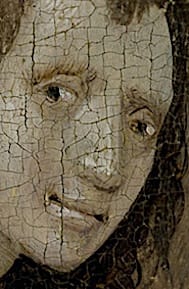
A staging of the gazes between man, woman, bird – and viewers.
The trio of gazes and gestures within the picture has one aim: the viewers. The man establishes a connection between the bird and the woman and invites us to reflect on it. I shall refrain from discussing that now too, and finally turn to the dream.
The sensual audacity and the enigmas of Bosch’s The Garden of Earthly Delights have a simple justification and explanation: he is depicting a dream. In a dream, it was more permissible to show daring details, which allowed for a greater freedom with sexual allusions. Furthermore, the painting is a so-called composite dream, a concept considered possible since the time of Gregory the Great. It also contains the type of dream known as a somnium, which does not convey its messages directly, but cloaks them in metaphors and allegories, which by definition had to be interpreted. The problems that have plagued the interpretation of the painting for 500 years consequently arise from its aesthetic conception: as a dream.
Reindert L. Falkenburg suggested that the picture served as a conversation piece designed to educate a youthful elite through entertaining discourse. One might call its purpose dream interpretation.
Numerous medieval texts are narrated as dreams. The technique, popular in literature since antiquity, of cloaking the unbelievable in dreams was extremely widespread by the end of the 15th century.
Many series of illustrations for the Roman de la Rose – which was extremely popular around 1500 – and for many other dream narratives begin with a scene of the dreamer lying in bed, often with a hand resting on their cheek. The Garden of Delights, however, presents a distinctive feature. The woman in the cave rests her head on her left hand and looks – from the viewer’s perspective – up to the top left. In a sense, she is still making the gesture of a dreamer, but she has awakened. She has been dreaming; she has just awakened, just like the dreamer at the end of the Roman de la Rose – a scene that was rarely illustrated.
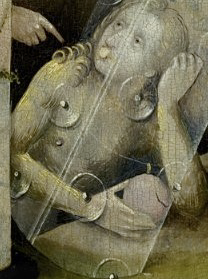
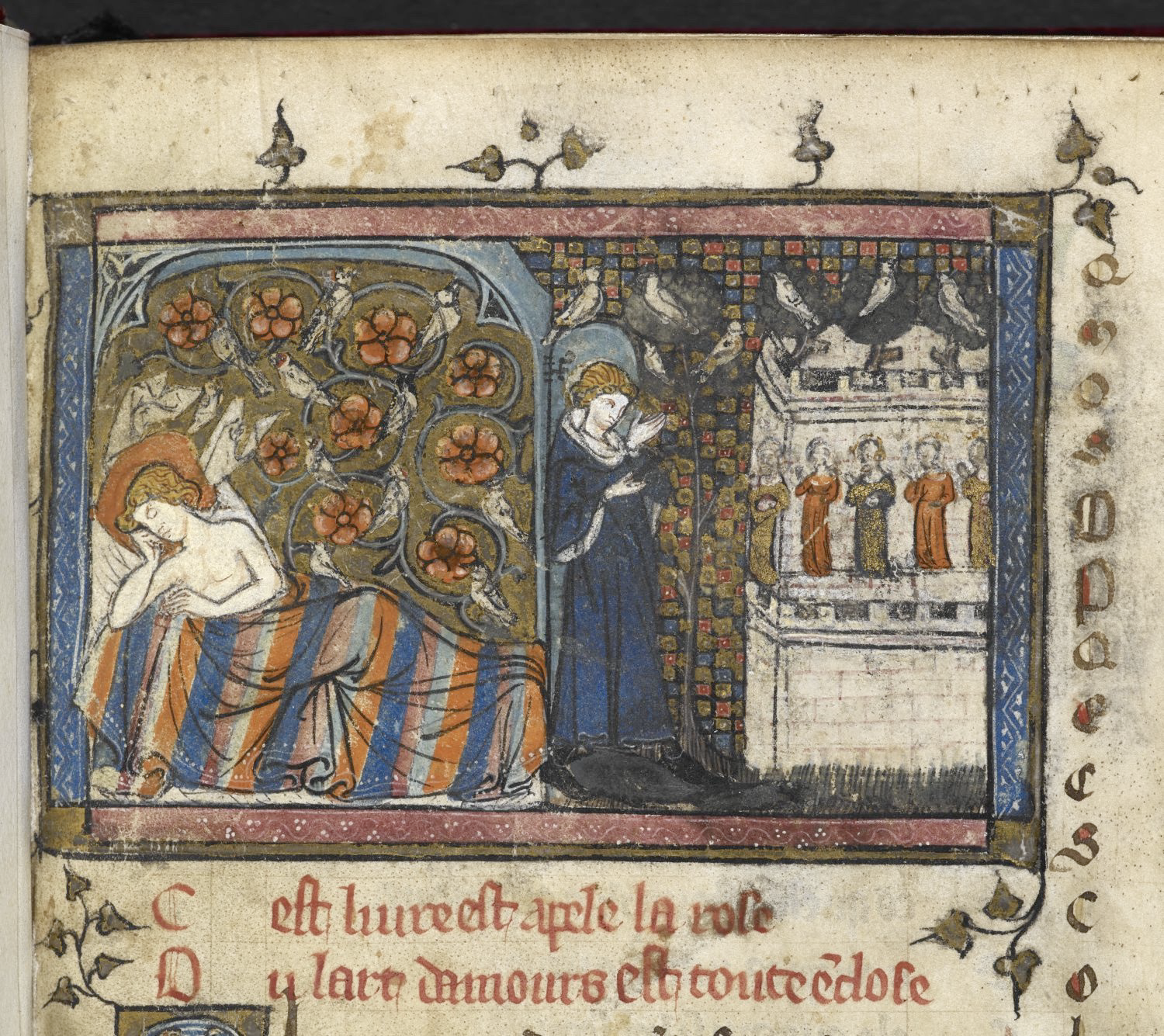
The dreamer’s head turning from her hand and an opening miniature from the Romance of the Rose depicting the dreaming lover and the beginning of his dream.
Occasionally, the figure has been interpreted as a melancholic Eve, resting her head in her hand because of the Fall. A hint of melancholy is possible, yet the head by no means lies heavily in her hand; the figure is clearly already a step further along. How much of Eve there is in her is, for the moment, of secondary importance (the fruit in her hand bears bite marks).
For now, let us simply note that this is a thoroughly conventional gestural trope of the dream depiction – easily confused with other meanings of the hand on the cheek – and is employed from the tradition of book illumination. The essential elements of a simple dream constellation, as defined by Jean-Claude Schmitt, are present: firstly, the figure who is dreaming is shown (albeit shortly afterwards). Secondly, the dream is depicted; it begins immediately before the dreamer’s cave, as is also familiar from many book illustrations.
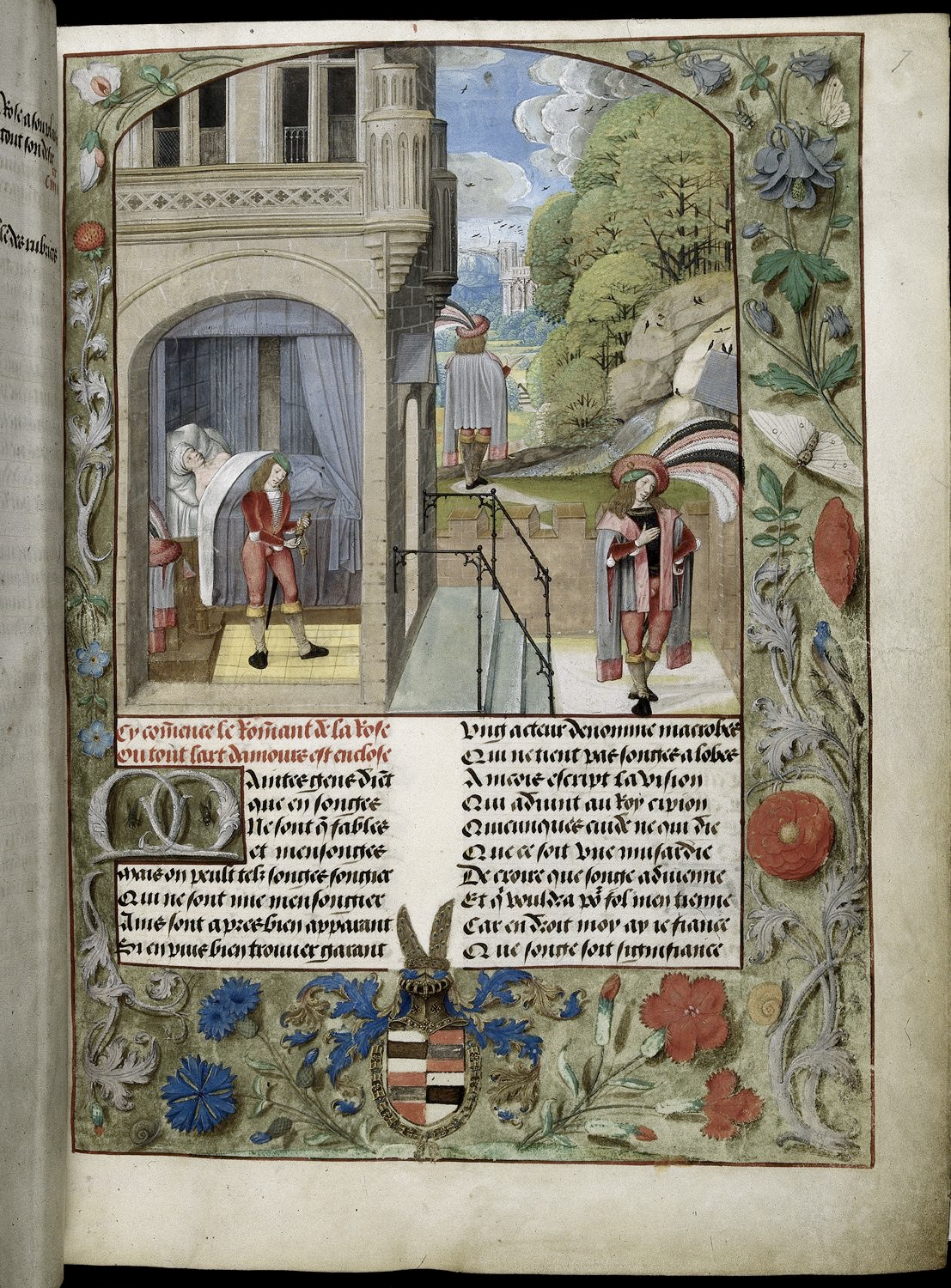
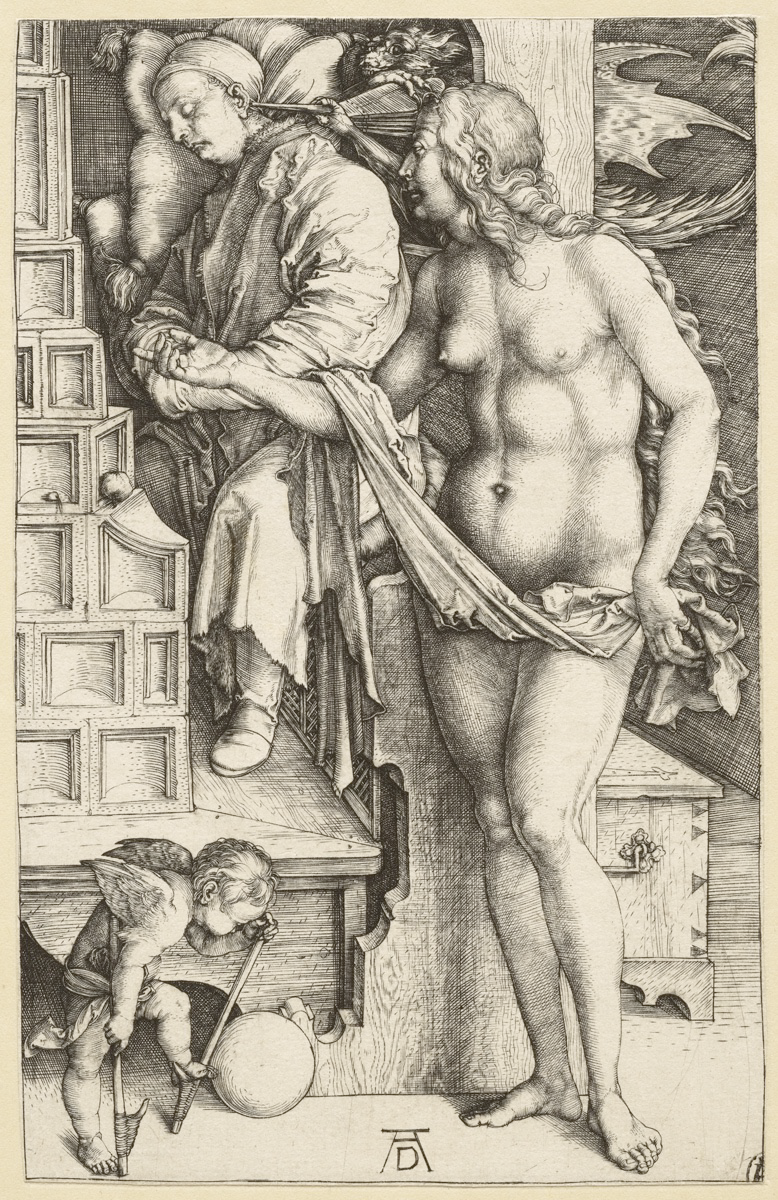
The dreamer and the content of his dream are ‘equally real’ side by side. In Dürer’s work, too, the content of the dream – the woman – becomes a seemingly real apparition.
One often sees the dreamer and the dream depicted simultaneously. The opening illustration of the Romance of the Rose is composed in this manner in a manuscript that was perhaps commissioned by Engelbert II of Nassau between 1490 and 1500. The person who dreams and acts is seen on several occasions: in bed, then a second time still inside the house, and subsequently twice in front of the house. The action of the dream is thus very often, it should be emphasised once more, initiated without any distinction between dream and the dreamt. The contrast between sleeping and waking, dream and reality, is not played out, but rather obscured.
At times, the suggestion of a dream in the early modern period seems to have been precisely about blurring the line between dream and the dreamer, for example in Albrecht Dürer’s copperplate engraving The Doctor’s Dream. The naked woman in the foreground, as realistic to the eye as the rest of the picture, is the dream of the sleeping man, into whose ear a devil with a bellows is blowing evil images. These examples illustrate that there are various casual methods of indicating a dream and keeping it hidden. Yet the moment a ‘dream form’ shines through a composition, a dream should be suspected.
The third element of the structure of a dream representation according to Jean-Claude Schmitt is also present: those compositional details that connect dreams and dreamers – almost regardless of the means used. For what happens immediately in front of the cave and inside the cave acts as a link between the dreamer and the dream.
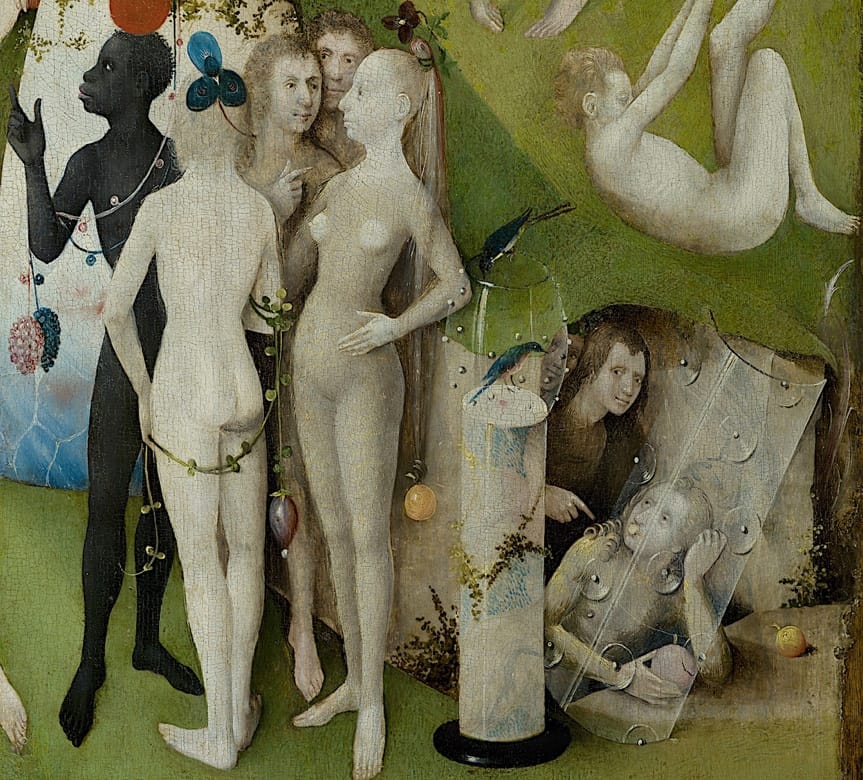
For example, in both instances a man points his finger at a woman. The parallel scenes correspond to the experience of a ‘final dream scene’ slipping from the dream into consciousness, for instance when the ringing of an alarm clock replaces a sound in the dream, and so on. The first waking scene and the final moment of the dream share details that are similar and link the two states together.
The painting in the final version differs from the preliminary sketch. The depiction of the figures in front of the cave confirms the idea that dreaming takes place inside the cave, and that the dream events unfold in front of it.
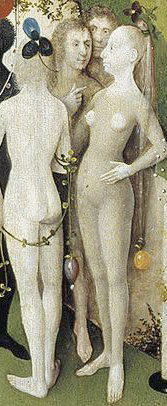
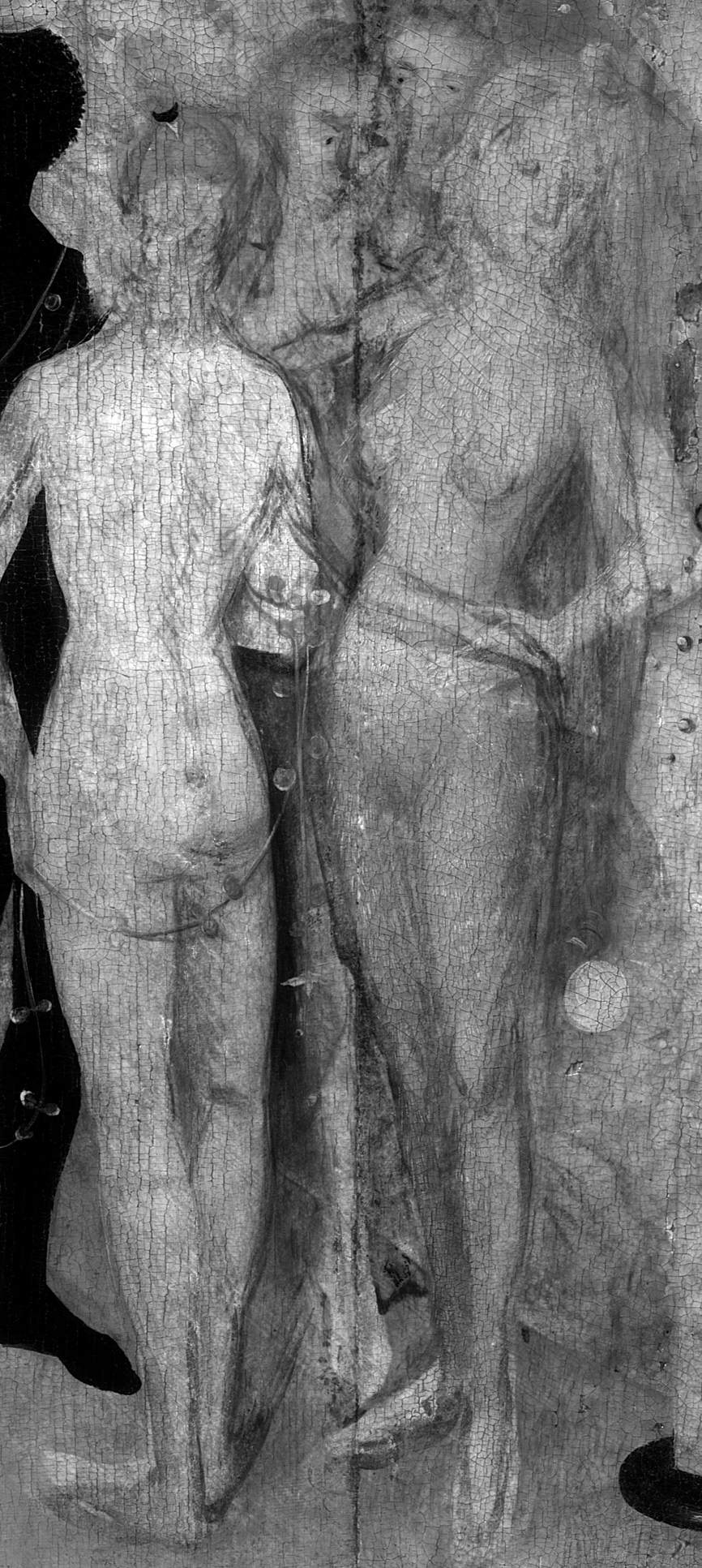
In the preliminary sketch, the hairy woman was turning towards the cave.
According to the preliminary sketch, the hairy woman standing directly in front of the cave – who, in the painted version, is looking to the left in profile – should be turning towards the cave. She should be looking down to the right, towards the cave. The woman seen from behind to her left – as can still be seen in the infrared reflectography – should be looking at her and placing her right arm around her waist, as if to prevent her from moving towards the cave.
The first woman in front of the cave, that is, the ‘last’ one in the dream, should thus, in the drawing, ‘wiggle out’ of her neighbour’s embrace and turn away spatially ‘out of the dream’. Undoubtedly, this would have supported the logic of the dream: with a final dreamt gesture from her alter ego, the woman in the cave awakens from her dream. Why this drawing was altered is a matter for discussion.
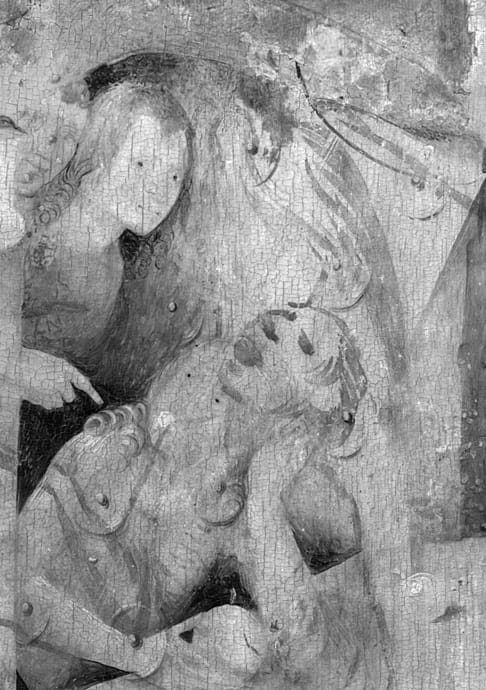
Here, merely a note that in the so-called Golden Letter of William of St. Thierry there is a dream motif that may explain the design for the bird on the woman’s head. There is mention of the striving of the seeking soul on the path from a sensual, earthly destiny to a spiritual, rational faith. This servant of God has made progress, but is repeatedly thrown back and tested by his former thoughts (my emphasis): ‘Thus, at the time of psalm-singing, prayer and other spiritual exercises, pictorial images and phantoms of thought circle in the heart of the servant of God, even though he does not want them and struggles against them. Like unclean birds alighting upon him or fluttering around him (uelut auibus immundis insidentibus circumuolantibus), these either snatch the sacrifice of devotion entirely from his hand, or at least so disfigured it that the one offering the sacrifice bursts into tears.’
In terms of visual rhetoric, to return to the dream, it is certainly highly ingenious to make the woman in the cave the opening figure and, at the same time, to have her awaken. For what follows is, rhetorically speaking, extremely condensed: the figure with her hand to her cheek draws one, as tradition would have it, into the dream, into the visual narrative. Yet the slight shift, the centimetre’s distance, the gentle turn of the head convey: she has awakened. The dream begins and ends here. Rhetorically, ‘nothing else fits in between’.
In the ‘gesture of dreaming and awakening’ of the woman in the cave, rhetorical device and allegorical meaning-making merge, for the awakening is not merely end of a narrative, but a religiously significant achievement. At a single point, a single moment, the beginning of the narrative, the dream of the right and wrong use of the senses, and the rescue from the dangerous aspects of the dream – rhetorically as awakening, allegorically as salvation. But can this succeed, given her abuse of the senses (see the links at the beginning)?