Doubts? Doubts!
Bosch research is paved with errors – how could it be any different this time?
For anyone familiar with the previous explanations of the Garden of Earthly Delights, what has been outlined here in the first ten posts must sound incredible. Does it not seem downright impossible that a comprehensive psychological system (see here, here and here) could have been overlooked for so long in the Garden of Earthly Delights? Scepticism is very much warranted; doubts are always useful. Research into Bosch’s work is paved – how could it be otherwise – with errors. In fact – and this is not coyness – it has not yet been established whether the approach presented here can establish itself as a new paradigm in the understanding of the painting, or whether I must be classified as the most diligent wanderer into error since Wilhelm Fraenger.
The line of reasoning outlined here from 1 to 10 must not only withstand these doubts (‘how can that be?’); it has its own shortcomings. The beginning seems tricky. Why should the Wheel of the Senses have been projected into the landscape and thus concealed?
First of all – taking the painting as my starting point – there was a structure based on the number 5 that had not previously been given any attention. The closer I looked at it, the clearer it became how intensely Bosch had brought it out, particularly in the upper section, by connecting the ‘fruit shells’ with one another.
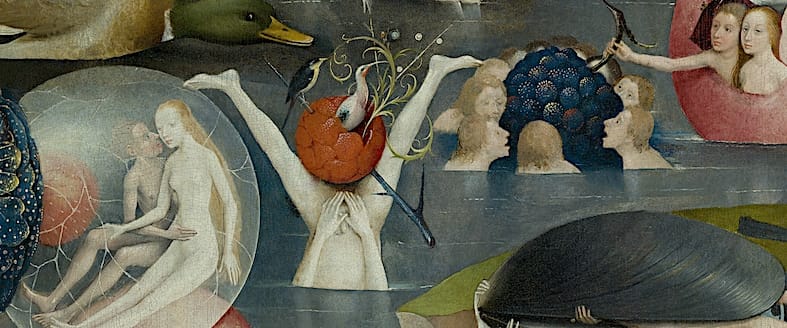
This is done as casually as it is formally elegant. The man upside down, his hands on his genitals (Erik de Bruyn provided a knowledgeable and highly entertaining account of the literary background to this in the 2016 Madrid catalogue), spreads his legs and connects the senses of sight and smell with pinpoint precision right down to the tips of his toes.
From the sense of smell, the circle continues to the ‘final’ sense of hearing: through the arch formed by the thistle blossom and the butterfly, which seem to lean across, as well as through the long, pale thistle stem and the great tit (see the following illustration). In the lower section, figures fulfil this compositional function of linking the stations of the wheel.
This pattern of five therefore called for an explanation. Observation is followed by thought. If this thought is not dismissed, it gives rise to a thesis. Specifically: first of all, other meanings for the structure of five – such as five stages of love or five stages of sin, five wounds and many others – had to be ruled out. The entry for the number five in Heinz Meyer and Rudolf Suntrup’s Lexikon der mittelalterlichen Zahlenbedeutungen comprises 39 columns.
In this process, the first three stations of the five-part structure could quite quickly and plausibly be explained as taste, touch and sight: the thesis of the five senses was an obvious one. Consequently, the figure carrying the mussel shell inevitably comes into focus as a striking sixth point, as the hub of a wheel of the senses.
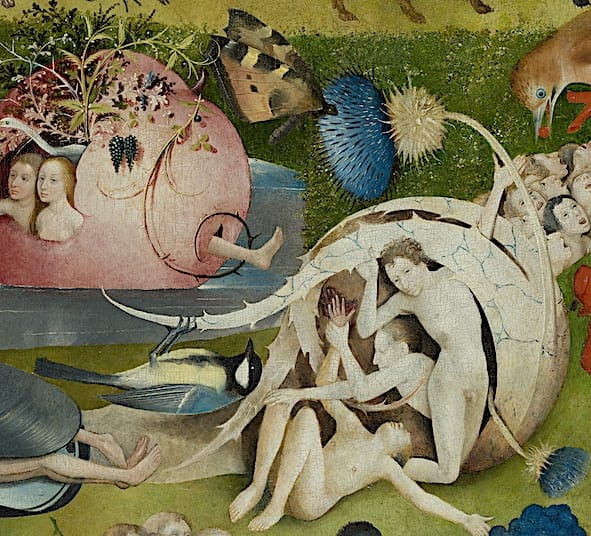
At this point at the latest – though, according to Karl Popper, much earlier – the matter shifts from induction to deduction – a shift that is unavoidable. This means that, step by step, one scans the surroundings for anything that might confirm the thesis. Everything else falls through the cracks, at least until attempts at falsification are made.
Now, art history is a science that is rarely logical, and yet, time and again, it arrives at better results. The first criterion for the novelty of a thesis – to provide a more precise explanation of the subject under investigation – has, in any case, undoubtedly been met: for the first time ever, a significant part of the central panel has been explained in detail.
Without digressing: the identified Wheel of the Senses – dating from around 1500, long before any established convention on the subject – naturally suggested that one should continue the search within this milieu, focusing on the soul and its powers. It is obvious that the system of the inner senses – the powers of the mind – and the five external senses then mutually confirm one another in a circular argument. To put it loosely: speculating, on the basis of the premise – that is, the model of the five external senses – that a model of the inner powers of the mind might also be staged is not logical in itself, but it is heuristically obvious. As the thesis took shape, this occurred, to use a term from critical rationalism, as empirical corroboration. If one surveys the interplay of details that characterise the system of mental faculties in the Garden of Earthly Delights even quite precisely, one – or at least I – would be reluctant to assume that all this could be a coincidence. Or could it be a coincidence after all?
Is it perhaps wrong from the outset, and is it not at all permissible to extract a Wheel of the Senses from the depths of the landscape? A false premise as the starting point for a piece of intellectual acrobatics – respectable, at any rate – that draws on hundreds of pictorial details, for which theology, pre-psychology and general intellectual history provide thousands of arguments, with which a result that is certainly fascinating but fatally wrong has been concocted? I am not being coy.
I have already stated my first counter-argument: the painter made excellent choices that strongly suggest a five-part structure in the landscape. One can work with this premise. Secondly: the premise allows for a beautifully detailed and complex understanding of the painting. But, once again, no theory has, a priori, a higher truth content than a fragmentary theory simply because of its greater consistency.
The painting also gains a socio-historical context; it reflects the debates surrounding imagination, reason and will around 1500. The Garden of Earthly Delights becomes comprehensible in detail and within its historical context (this remains to be demonstrated here). In contrast, earlier interpretations have tended either to explain only specific details or to dispense with concrete interpretations altogether, on the grounds that these were not even intended due to a ‘change of signification’ (to follow here).
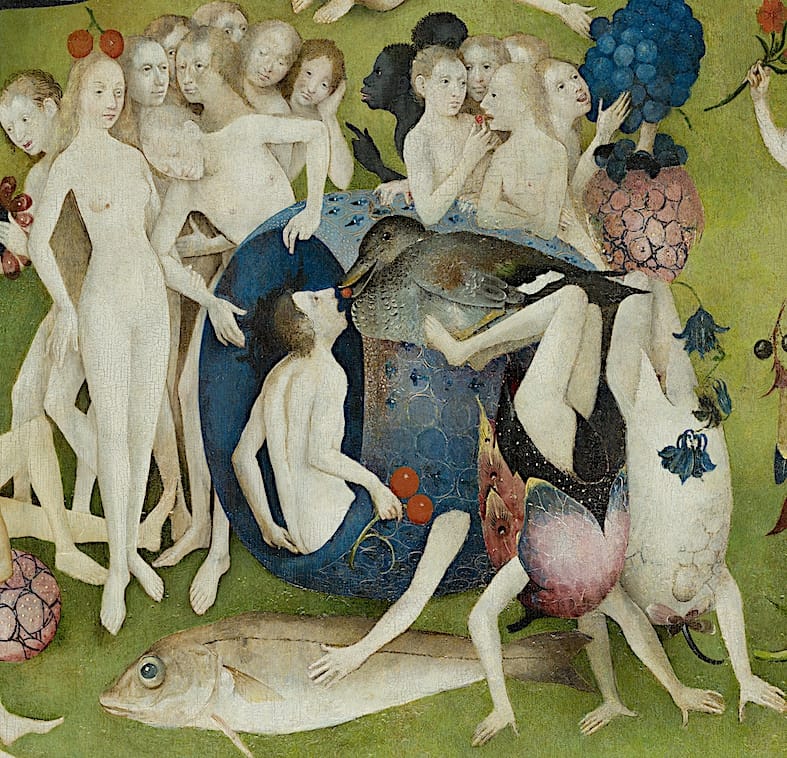
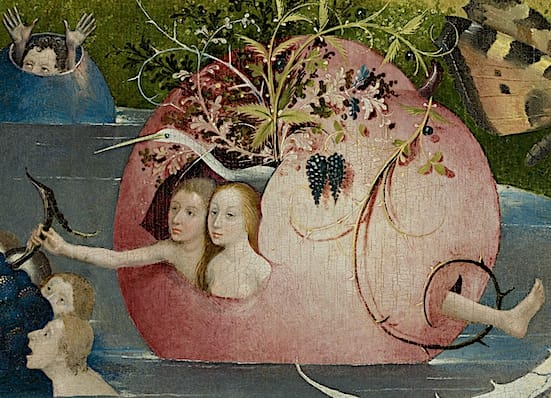
Methodologically similar in this respect too: on the right, a leg protruding from the shell – what might the missing body be doing? On the left, a superfluous arm reaching for the fish – what might the upper body or head be doing at that moment? Of course, the two birds also link the stations paradigmatically.
Doubts are productive and have already contributed greatly to the outcome. For a long time, I had been unable to explain the code of conduct satisfactorily, until a re-reading of William of Saint-Thierry opened up a better approach. Once the tree-tent had been identified as the form of the intellect, I initially thought that the Augustinian triad of memoria, intelligentia and voluntas was being staged. That didn’t hold up. Accordingly, the identification of the central portal and its annexe as imagination/memory, and of the whitish-bluish column stump as negative fantasy, also only became possible through doubting the theories held up to that point. Until 2018, I thought the woman in the so-called cave was awakening from her dream of sin (with didactic elements) and that all was well. It was only later that I came to understand the infamy accompanying this awakening. It was only through Rosa Alcoy’s 2020 book (El Bosco en dos trípticos del Museo del Prado) that I gained certainty regarding the earlier thesis that, from a theological perspective, Hell is a vision based on Psalm 68 (Vulgate) (an article on this will follow). In fact, it was only last year that I realised that closing the gap in the circle of horsemen – that is, the continuation of the ride after a brief halt – also has theological significance (a post on this will follow; a brief mention here). For a very long time, a parallel – albeit marginal, but useful as an argument – went unnoticed: The leg protruding from the fruit shell for the sense of smell links this station with the fruit shell for the sense of taste – where one arm too many likewise prompts the question of the body it belongs to, just as the leg does at the sense of smell. This parallel provides a further argument for considering how the fruit shell much further back in the landscape and the one in the centre of the foreground belong together.
What follows here will be relatively spontaneous and dependent on other commitments. It will not be too long before I return to the temporal structure (10). First, however, in the next post (12) I shall discuss the prejudices that have hindered some Bosch research. The search for the ‘key’ or ‘keys’ to the door leading to the Garden of Earthly Delights ceased altogether. People were content with the few holes which, according to Panofsky, were all that had been bored through this door.