Sex and fantasy
The imagination captivates the willing viewer – and is denounced as diabolical and bizarre
We have already briefly touched upon the fact that sex is hinted at but concealed beneath the surface. Reindert L. Falkenburg, whose findings on the Paradise panel are essential for understanding the painting, has also drawn attention to this. For him, the hidden sex is one of the aspects of the painting which, in the gentle sunlight of the central panel, suggests that something is amiss there – something which subsequently erupts in the Hell panel. I am referring here merely to three or four details and discussing the apparent paradox that these scenes require precisely the imagination which is denounced within the powers of the mind.
We have already discussed the couple in the shell and their sex, which contravenes the notions of marital intercourse for the purpose of procreation (see here), as well as the ménage à trois in the portal’s canopy (see here).
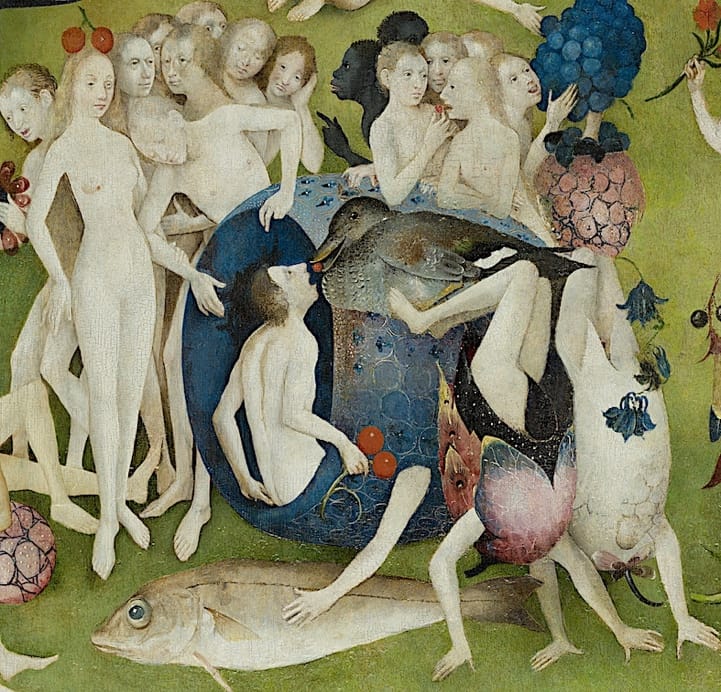
The salacious goings-on surrounding the sense of taste have only been mentioned. The woman on the left, with the two giant cherries on her head, is behaving in a highly questionable manner. Her frivolity is not immediately apparent amidst the tangle of limbs. It is generally agreed that crossed limbs in such situations indicate sexual activity. The woman is touching two men at the same time, and not exactly shyly. With her right hand, she touches the man behind her on the thigh, whilst at the same time she intimately pulls the forearm of the man to her left towards her. The two cherries on her head reveal the nature of her touch. The man being fed by the duck is holding the same cherries in his hand. There, the superfluous arm reaching down towards the fish is perplexing – following Dirk Bax, presumably a symbol of the penis. The imagination must work to picture the body for this arm, the posture and the location of its head. Once again, the two round fruits – testicles with a stem – set the tone. The imagination must piece together what is happening behind the shell.
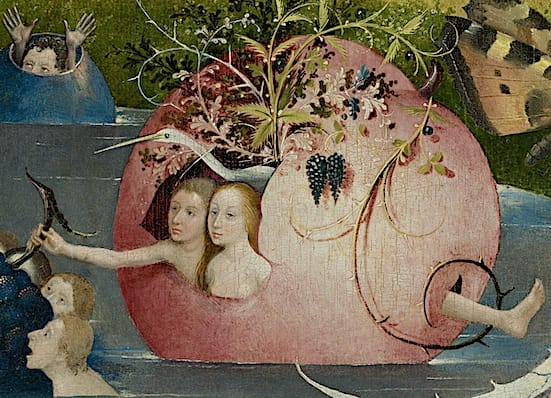
Reindert Falkenburg recommended taking a closer look wherever faces seem to have fallen into a kind of somnambulistic trance. Would that also apply to the slight shift in the woman’s gaze in the Sense of smell scene? But to be honest, my imagination isn’t enough at this point to make a delicate connection between the woman and the conspicuous left leg/foot on the right-hand side of the fruit peel.
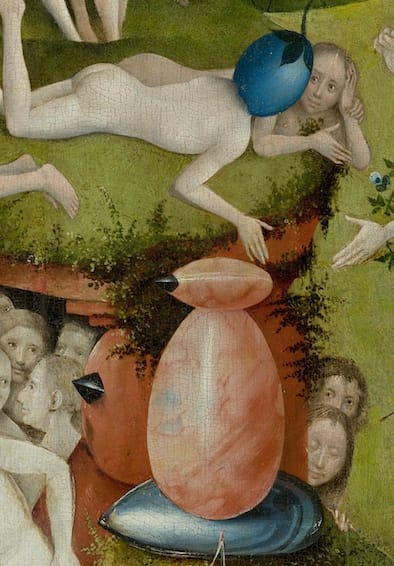
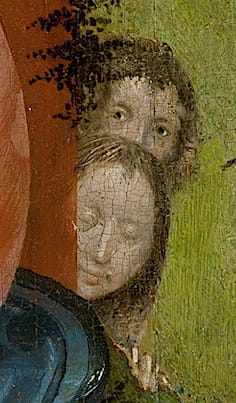
Ecstasy (below, enlarged on the right) as an argument for the relevant discussion (above).
Of another suspicious couple, only the two heads are visible. Comparable to the events taking place in the canopy of the portal, the gaze of the man standing at the back is clear. The eyes of the figure at the front – whether man or woman – are closed, yet hardly in sleep. The gestures of the couple above indicate that they are discussing what is happening below. Erik de Bruyn has shown that, based on literary sources, the man’s blue head characterises him as someone who thinks with his member. His right hand points downwards. His left hand’s grip around the woman’s wrist perverts the Creator God’s grip on Eve’s hand in Paradise and reveals his intention to emulate the couple below. She, however, seems reserved.
So much for this little Kamasutra, which undoubtedly requires a bit fantasy. Now the depiction of the Powers of the mind (see here, and here) needs to be supplemented with regard to what is specifically conveyed about the fantasy. It may come as a surprise: in The Garden of Earthly Delights, a ‘gold standard of the imagination’, the creative, inventive imagination – fantasy – is viewed in a rather negative light.
On the basis of their positioning and formal character, the tree-tent triangle could be identified as a symbol of the intellect (or reason), the soiled portal as the reproductive imagination, and the extension behind it as memory, from which, during sleep, contents surge forwards and upwards (see here); the punchline was provided by the evaluative, estimative scene of the young birds being fed behind the tree-tent.
By understanding the third small-scale architectural feature, the light-coloured column stump, as a separate station – yet one visibly connected to memory and imagination – as phantasia, a conclusion can then also be drawn regarding the four ‘Towers of Paradise’ in the background.
The small-scale architecture for the phantasia is very precarious. A smooth shell lies on the vegetation of the whitish-bluish-unreal column as if in a nest (this is an indication of animality). The slanted, precarious placement of the shell is surpassed by the unstable position of the vertical marble ice above it. As phantasia, a formal atmosphere is thus celebrated that seems to warn that figments of the imagination can collapse like a house of cards.
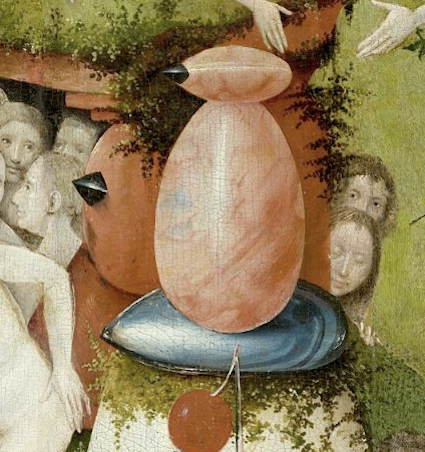
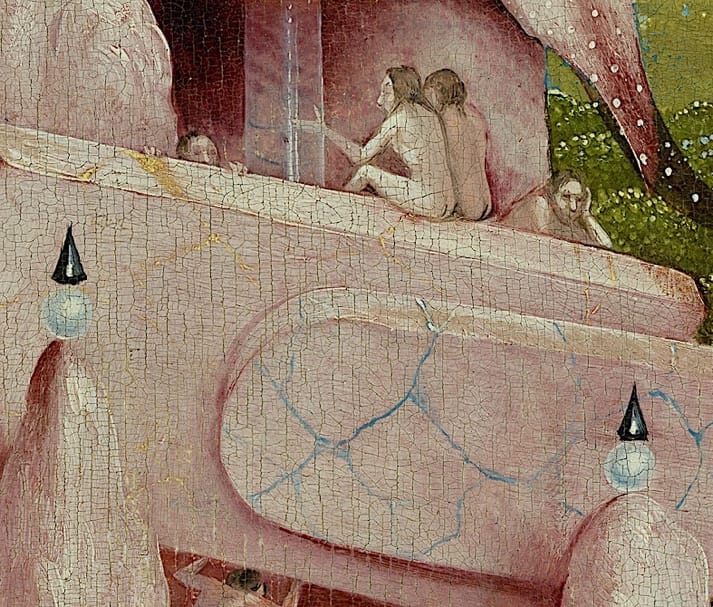
An unstable construction with black thorns, only here in the foreground and background.
Round on pointed varies with round on smooth. The upper baseball-like form has a diamond-cut thorn on the left, here resembling a beak. This thorn appears again immediately behind it, now on the bulbous form directly at the exit of the extension. This establishes a connection between the extension of the portal (reproducing imagination/memory) and the whitish-bluish column (inventive imagination: fantasy). In contrast, there is no connection from the portal to the left towards the tree-tent, towards the intellect. For the reason rests in sleep and cannot intervene in what emerges from memory into the dream. In contrast, the doubled black tips indicate a connection between memory and fantasy.
The black tips appear in the foreground only here, and in the background at just one point. There, these tips crown the pillars of the left-hand gate. In my view, this is no coincidence, for a connection of sorts – one based on ‘form’ – becomes apparent. The irregular, fantastical towers in the background are the result of the chaotic, unstable imagination depicted in the foreground.
For the curious instability of the whitish-bluish column as a form for the fantasy also appears in the foreground only in this symbol, to the right of the portal – and indeed in the background.
Attention should be drawn to a particularly unstable construction. At the top of the second gate of paradise from the right, the painter has devised a truly acrobatic arrangement.
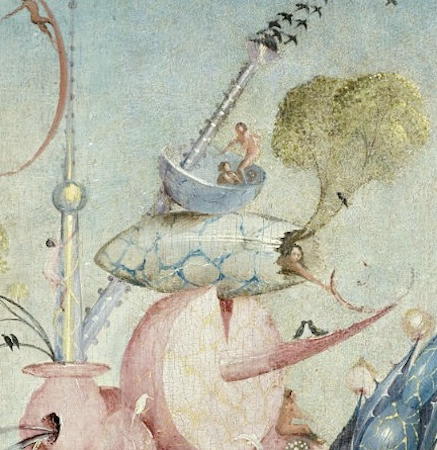
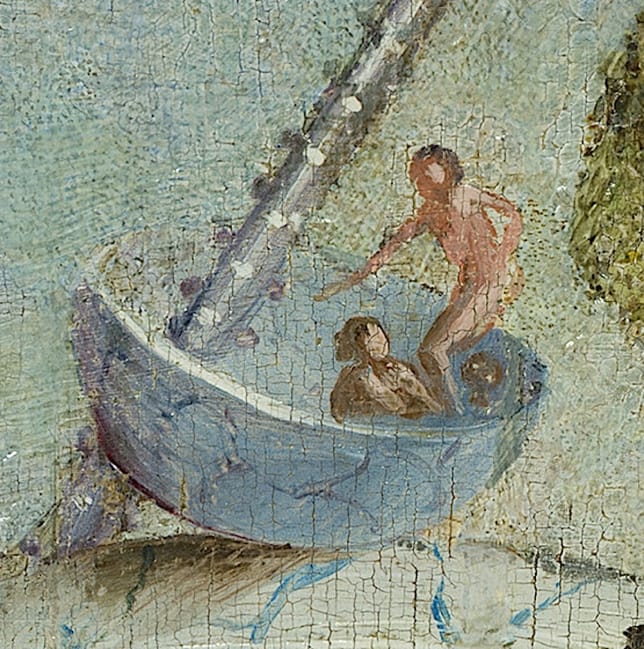
An unstable construction in the third Tower of paradise with decorative allusions to the ‘Pillar of fantasy’.
To begin at the top: the figure standing at the front in the half-shell ‘boat’ seems to be struggling to keep its balance. The tilt of the bowl and the figure’s careless posture indicate that something there is losing its balance.
In fact, the ‘boat’ appears to be secured by the ribbed tube piercing the bowl. Yet the reality of this tube is unclear; it seems to vanish behind the spindle, open on the right, from which young trees protrude. This horizontal spindle varies the white-bluish decoration of the ‘Pillar of Fantasy’ in the foreground. And it echoes the balancing act: the spindle, too, lies precariously in a gap in the reddish hemisphere below.
There are not many details that give rise to the suspicion that there is a connection between the small-scale architecture for the fantasy and the fantastical forms of paradise. However, the towers themselves confirm it.
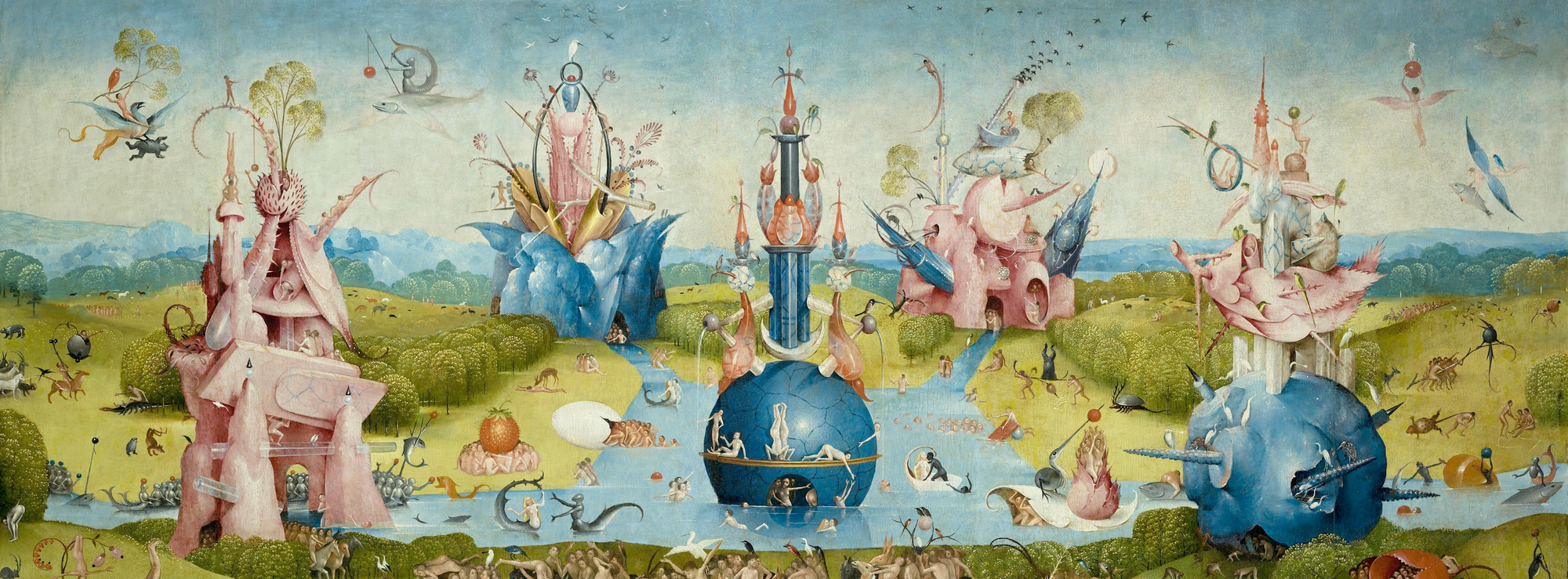
They are generally characterised by instability and chaos, fragility and confusion. What stood out as an anomaly on the blue-whitish column becomes the norm at the back.
The four gates, characterised as Gates of Paradise by their number and the four rivers flowing through them, are perverted Gates of Paradise, products of a dream inspired by the fantasy and uncontrolled by the mind. Paul Vandenbroeck, in particular, has made it clear that the arrangement of the towers also evokes the heavenly paradise. The way they are dreamt here is nothing short of a scandal.
When one considers what Bosch research has revealed about the painting so far, one must fear that my interpretation may seem far-fetched. Might it not be possible that a rather naïve understanding of ‘dream’ underlies this, in which imagination plays no part?
However, The Garden of Earthly Delights is conceived, by virtue of its pictorial composition alone, as a special ‘imagination’. The painting is not merely, like any other, a realisation of a painter’s imagination. For it is staged as the imagination of a figure who is dreaming or has dreamed. We see her, her dream, her imagination.
The question of how imaginatio or imagination, creative power or phantasia became a sub-theme in The Garden of Earthly Delights is also because the Latin inscription on Bosch’s drawing The Forest Has Ears, the Field Has Eyes has for many years raised the question of what role invention might have played for this painter in a self-reflexive sense. The inscription disparages lesser talents who invent nothing new and always use existing solutions, and advocates the invention of something new.
Furthermore, Reindert Falkenburg had shown how, in the Creation scene of the paradise panel, different pictorial types are blended into one another. Imaginative activity is required. It is only through this mental exercise that one can recognise, for example, the theological impulse of grace that it is not Adam and Eve, but Christ and Eve who form a bridal couple – as Dirk Bax and Paul Vandenbroeck had already observed, but only Falkenburg has discussed the implications of.
Fantasy and imagination were topics of interest around 1500. Although the terminology varied at times, the psychology of the soul distinguished between a faithfully reproducing faculty – which faithfully recreated perceptions that were no longer present in the current moment (usually referred to as imaginatio) – and creative fantasy, which, by contrast, creates anew, combines, reshapes, and produces unreal things. This distinction originates implicitly from Aristotle and pervades the entire Middle Ages. In the Dutch-speaking world, too, the distinction between imaginatio for the more reliable operations of the soul and phantasia for the more risky ones had become established. This is illustrated by the words ‘verbeeldinge’ and ‘imaginacie’ on the one hand, and ‘fantasie’ on the other, which refers exclusively to illusory and delusional constructs. The phantasia benefits most from the absence of reason: around 1500, it was the decisive force of the soul responsible for dreams.
Gianfrancesco Pico Mirandola held a different view, but what he wrote about the dangers of imagination applies verbatim to psychology and the Tree-Man in The Garden of Delights: ‘But if a person becomes an animal in their life and behaviour, this is the consequence of having submitted to the rule and guidance of the fantasy.’
In this respect, it is no paradox that the triptych, on the one hand, sets the imagination/fantasy beautiful tasks, yet on the other hand denounces it for inventing bizarre notions of paradise.