Other doubts and objections
Is every effort in vain? Is the Bosch Garden a hidden-object picture without any precise meaning?
In a keynote address at the 2016 Bosch Conference, Larry Silver asked why Bosch research had made so little use of Reindert Falkenburg’s findings. Although Falkenburg’s book, The Land of Unlikeness: Hieronymus Bosch, The Garden of Earthly Delights, had only been published five years earlier, he had already presented key aspects of it beforehand, including at a Bosch conference.
Falkenburg’s book did not fare well in the reviews (I am not familiar with all of them); some came from colleagues who had already written about the painting themselves and were unable to set aside their bias. This is a pity, because Falkenburg’s precise observation refines earlier sweeping generalisations, according to which the Paradise panel deals exclusively with the biblical couple Adam and Eve, their marriage, God’s bringing of Eve to Adam, and His command ‘Be fruitful and multiply!’. Falkenburg significantly expanded this interpretation. He made it clear that the contact between Adam’s foot and Christ – with Adam’s feet crossed – is inescapable. For at the same time, on the opposite side, there is an allusion to the birth of Eve, and then this Adam is (almost) ennobled: not only is the birth of the Church (on the cross) evoked typologically, but in his deep dream whilst Eve is being created, Adam shares in the great mystery, the sacramentum magnum, hence his wide eyes. There is more here than ‘marriage commandment’, ‘procreation’, ‘fertility’.
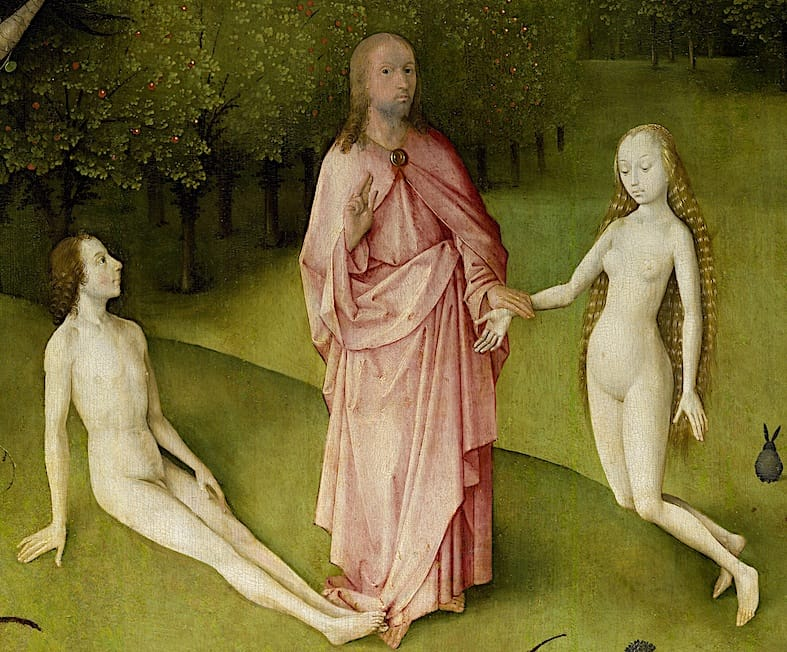
This typology always resonates in the background. Where there are indications of it, it must be taken into account. Falkenburg elevated it, as a ‘para-typological’ principle of recollective seeing, into the very hallmark of the triptych. Either this emphasis made his interpretation vulnerable to criticism, or his critical colleagues, in fending it off, overlooked the general validity of the typology – which, given the clues in the painting itself, is negligent. Furthermore, there was fundamental criticism of this kind of iconographic and iconological analysis; see below for more on this.
Bosch research, in any case – but where is it any different? – takes crooked paths. In the long-standing battle against the popular theories of Wilhelm Fraenger and against various ‘esoteric adepts’, researchers had at times dug themselves in on a rather national, indeed regional-Brabantine footing; they had placed too much trust in the folkloric knowledge of Dirk Bax and had lost interest in theological explanations.
It should be noted in passing that the Garden of Earthly Delights, although the subject of a flood of publications, was scarcely affected by the various ‘turns’ between art history and visual studies. We shall discuss an earlier exception. It explains why the triptych has recently been described repeatedly as hermetic or at least as deliberately ambiguous – so that, it is claimed, any effort at a detailed understanding of it would be futile.
The literary scholar Albert Cook was probably the first to discuss the difficulty of reading the triptych from a semiotic perspective. He identified the reason for this as a ‘change of signification’, as indicated by the title of his 1984 essay. Put simply, Cook argues that, unlike other painters, who painted familiar themes – and thus used a familiar ‘language’ – with recognisable subjects and details, Bosch invented both the theme and the visual ‘language’. In Cook’s view, his imagery and its inventions – much like Botticelli’s Primavera, for example – relate almost exclusively to his own narrative. Yet this narrative is unknown, heterogeneous and unsurveyable, multifaceted and diverse. Bosch, he says, creates forms and pictorial elements for which there is neither a concept nor a sum total, and he violates rules. Consequently – and this is what matters to Cook – the ‘univocal reading’ is precluded per se. ‘Consequently even the most strenuous attempts to provide a plausible univocal reading, a story, for The Garden of Earthly Delights, the Primavera… have notably foundered.’ In principle, Cook holds, it is not impossible to understand The Garden of Earthly Delights, it is characteristic of Bosch. ‘to create a new and powerful visual algebra whose equations we are just beginning to learn to read‘.
Keith Moxey also adopted a semiotic approach in his essay Hieronymus Bosch and the ‘World Upside Down’ (1994). Influenced by visual culture and the pictorial turn, Moxey went a step further. Whilst he welcomed the cultural-historical aspects explored, for example, by Paul Vandenbroeck, he countered that Bosch’s ‘visual motifs did not possess the specific meanings’ that had been read off them. Instead, he held that Bosch’s imagery was ‘to a large extent incapable of being read and that it was this very quality that enhanced its appeal for a humanistically educated audience.’ He discusses Bosch’s imagery from the perspective of his aristocratic patrons and buyers, to whom Bosch intended to commend himself as an inventor and ‘genius’. It was precisely these fantastical inventions, Moxey argues, for which the painter was esteemed in humanist circles, and that was exactly what they were created for.
The shift of cheeky details from the margins of book illustration – aristocratic art – to the centre of the painting, and the establishment of the subversive ‘world upside down’, popular among the nobility, served, according to Moxey, the same function. Bosch, he claims, had mixed together a fantastical pictorial surface, a hubbub of signifiers that are no longer signifiers because they no longer have any signifieds. His ‘deliberate creation’ was therefore, in Moxey’s words, ‘not a precondition to the work of interpretation’. Unfortunately, this narrowing of focus – understandable in the context of the visual turn – also formed the basis for Moxey’s review of Falkenburg’s book in 2012. He summarises: ‘The text-driven quality of the analysis, its obsession with iconographic meaning, falters in the face of a painting that so clearly seeks to escape linguistic entanglement. Falkenburg’s narrative fails to register the autonomy of Bosch’s visuality.’
Keith Moxey is a renowned scholar; his essay on Bosch has been regularly cited and has arguably contributed to the Garden of Earthly Delights being increasingly interpreted as ambiguous or ambivalent – or at the very least in the sense that iconic difference supposedly hinders precise analysis. This echo can be heard right up to Hans Belting (2002) and Reindert Falkenburg. Admittedly, these two and many others did not refrain from favouring one thesis over another because they considered it more plausible. One wishes to understand, and as accurately as possible. From my perspective – given the detailed precision of the system of the senses (here, here and here), the faculties of the mind (here and here), the moral appeal and the threat of punishment in hell (here and here), as well as the indexing of a dream (here) in a Garden of Earthly Delights that is then no longer unsurveyable at all – Moxey’s view looks thoroughly dated.